Jungfrau
📍 Bernese Alps, Switzerland
One of the great peaks of the Bernese Alps at 4,158 metres — reached, uniquely, by a cog railway tunnelled through the mountain to the Jungfraujoch, the 'Top of Europe', overlooking the head of the Aletsch Glacier.
What makes it marvelous
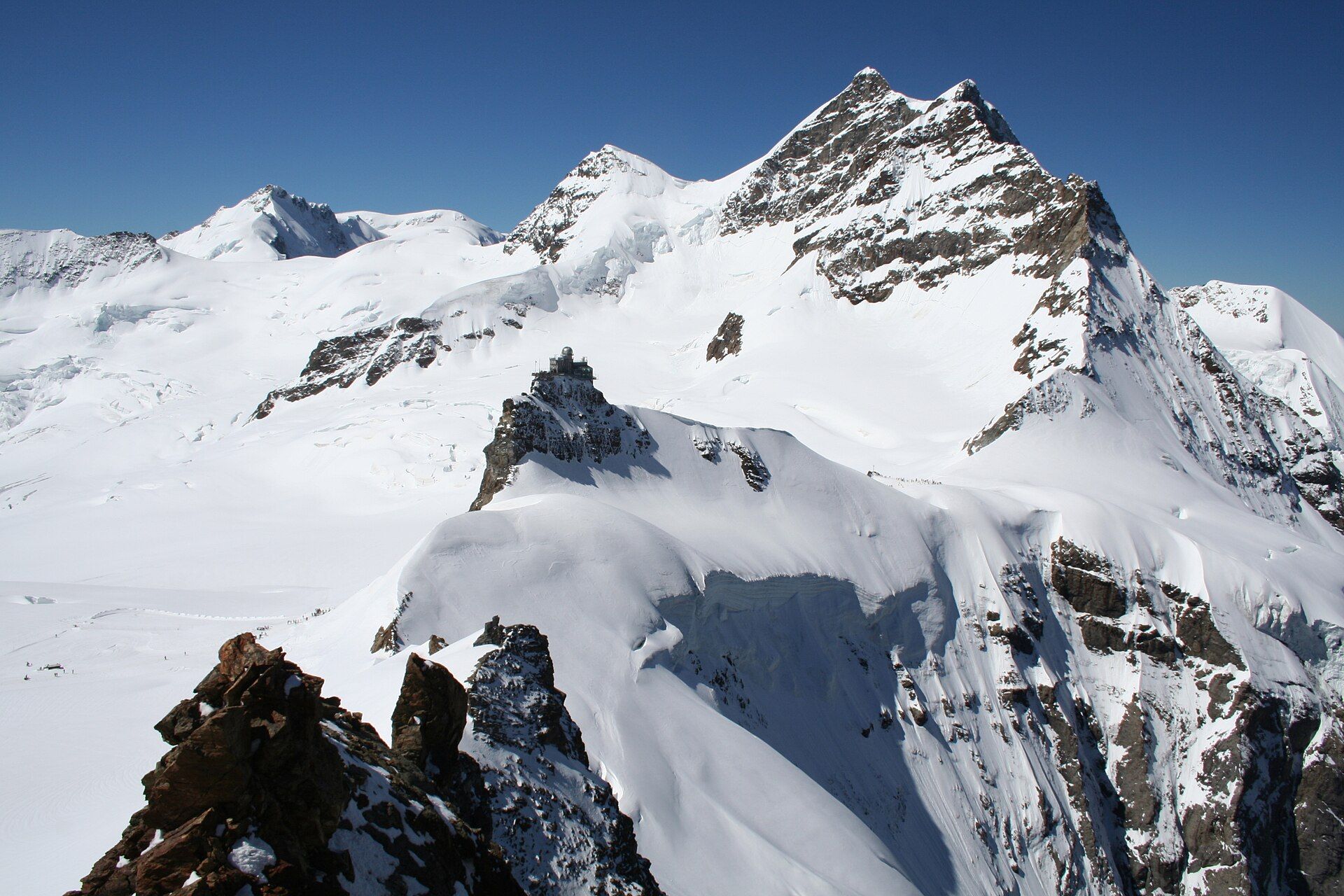
The Jungfrau rises to 4,158 metres, the third of the famous Eiger–Mönch–Jungfrau wall that dominates the Bernese Oberland, and its southern slopes feed the Aletsch, the largest glacier in the Alps. Its fame today rests partly on an engineering marvel: a rack railway bored through the Eiger and Mönch to emerge at the Jungfraujoch saddle at 3,454 metres — the highest railway station in Europe — where an observation terrace, an ice palace and a research station sit amid permanent snow. The whole massif lies within the Swiss Alps Jungfrau-Aletsch UNESCO World Heritage Site.
Why visit
It offers a genuine high-Alpine world without a climb: the railway carries you into permanent snow and ice, with views over the vast Aletsch Glacier curving away below and, on clear days, across to the plains and beyond. It is the accessible summit of Alpine tourism, paired with serious peaks for those who do climb.
Still deciding?
Jungfrau comes up most often against these — each one weighs cost, effort, season and crowds side by side.
More views of Jungfrau
Additional photographs of the actual site — each freely licensed, with its photographer and licence credited.
What to know before you go
🗓️ Best time
The Jungfraujoch railway runs year-round; late spring to autumn brings the most reliable weather and open high trails, while winter offers snow and clear cold spells — but conditions up top are wintry in any season.
🧭 Getting there & access
Reached by mountain railway from Interlaken via Grindelwald or Lauterbrunnen and Kleine Scheidegg, changing to the Jungfrau Railway for the tunnel section to the Jungfraujoch.
Good to know
- Check the summit webcam before you go up — the Jungfraujoch is often in cloud.
- Allow time to acclimatise; at 3,454 metres the thin air is quickly noticeable.
- Book ahead in peak season, when the railway and the terrace get very busy.
Plan your visit
Easy🧭 Getting there
From Interlaken, Bernese Oberland (via Bern or Zurich ZRH)
- Reach Interlaken by train from Bern or Zurich
- Take the mountain railways via Grindelwald or Lauterbrunnen to Kleine Scheidegg
- Change to the Jungfrau Railway through the tunnel to the Jungfraujoch
- Total travel
- Roughly 2–2h30 up from Interlaken
- Time at site
- A full day for the journey and the Jungfraujoch; longer to hike the region
- Access
- The railway operates all year to a published timetable; the tunnel journey and the Jungfraujoch charge a substantial fare. Weather at the top is alpine in any season, and services can pause in storms, so check conditions before travelling.
🎒 What to bring & consider
- Warm layers, hat and gloves — it is below freezing at the top even in summer
- Sunglasses and strong sun cream against fierce glare off the snow
- Sturdy shoes for icy terraces and any snow walking
- Water and a snack; take the altitude gently
👁️ What to expect
- Crowds
- Very busy in peak season and on clear days; the terrace and train fill early.
- Conditions
- Easy underfoot but genuinely high-altitude — thin air and cold.
- Facilities
- Extensive at the Jungfraujoch — restaurants, ice palace, viewpoints, shops.
- The view
- The Aletsch Glacier sweeping away from the Sphinx terrace under a clear sky — entirely weather-dependent, so pick your day.
Times and requirements are approximate and change with season, weather, and local rules — confirm permits, fares, and schedules with operators before you travel.
Natural riches of the area
- A 4,000-metre Alpine peak feeding the Aletsch Glacier
- The largest glacier in the Alps at its southern foot
- Permanent snowfields and high-altitude ecosystems
- Part of the Jungfrau-Aletsch UNESCO glacial landscape
Local food
- Fondue and raclette
- Melted-cheese dishes central to the Swiss Alpine table.
- Alpine hard cheese
- Matured mountain cheeses from the high pastures of the Oberland.
- Rösti
- Crisp grated-potato cake, a Swiss-German staple.
The Jungfrau is the graceful third of the great Bernese wall — Eiger, Mönch and Jungfrau — that rears above the Lauterbrunnen and Grindelwald valleys, topping out at 4,158 metres. Its southern flank pours into the Aletsch, the largest glacier in the Alps, and the whole massif anchors the Swiss Alps Jungfrau-Aletsch UNESCO World Heritage Site, a landscape prized as a showcase of high-mountain glaciation.
What sets the Jungfrau apart from other 4,000-metre peaks is that you can ride into its frozen heart. A cog railway, bored more than a century ago through the Eiger and Mönch, climbs to the Jungfraujoch at 3,454 metres — the highest railway station in Europe — where a research station, an ice palace and an observation terrace stand amid permanent snow. From the Sphinx viewpoint the Aletsch Glacier unfurls below in a long white curve. It is the summit of Alpine tourism: a genuine high-mountain world delivered, improbably, by train.
Jungfrau: common questions
How do you get to Jungfrau?
From Interlaken, Bernese Oberland (via Bern or Zurich ZRH): Reach Interlaken by train from Bern or Zurich; Take the mountain railways via Grindelwald or Lauterbrunnen to Kleine Scheidegg; Change to the Jungfrau Railway through the tunnel to the Jungfraujoch. Total travel time: Roughly 2–2h30 up from Interlaken.
When is the best time to visit Jungfrau?
The Jungfraujoch railway runs year-round; late spring to autumn brings the most reliable weather and open high trails, while winter offers snow and clear cold spells — but conditions up top are wintry in any season.
How long should you spend at Jungfrau?
A full day for the journey and the Jungfraujoch; longer to hike the region. Total travel time: Roughly 2–2h30 up from Interlaken.
What should you bring to Jungfrau?
Warm layers, hat and gloves — it is below freezing at the top even in summer Sunglasses and strong sun cream against fierce glare off the snow Sturdy shoes for icy terraces and any snow walking Water and a snack; take the altitude gently
Do you need a permit or guide for Jungfrau?
The railway operates all year to a published timetable; the tunnel journey and the Jungfraujoch charge a substantial fare. Weather at the top is alpine in any season, and services can pause in storms, so check conditions before travelling.
Is Jungfrau crowded, and what are conditions like?
Very busy in peak season and on clear days; the terrace and train fill early. Easy underfoot but genuinely high-altitude — thin air and cold. Facilities: Extensive at the Jungfraujoch — restaurants, ice palace, viewpoints, shops.
Added
More wonders to explore