Yuanyang Rice Terraces
📍 Yuanyang County, Honghe, Yunnan, China
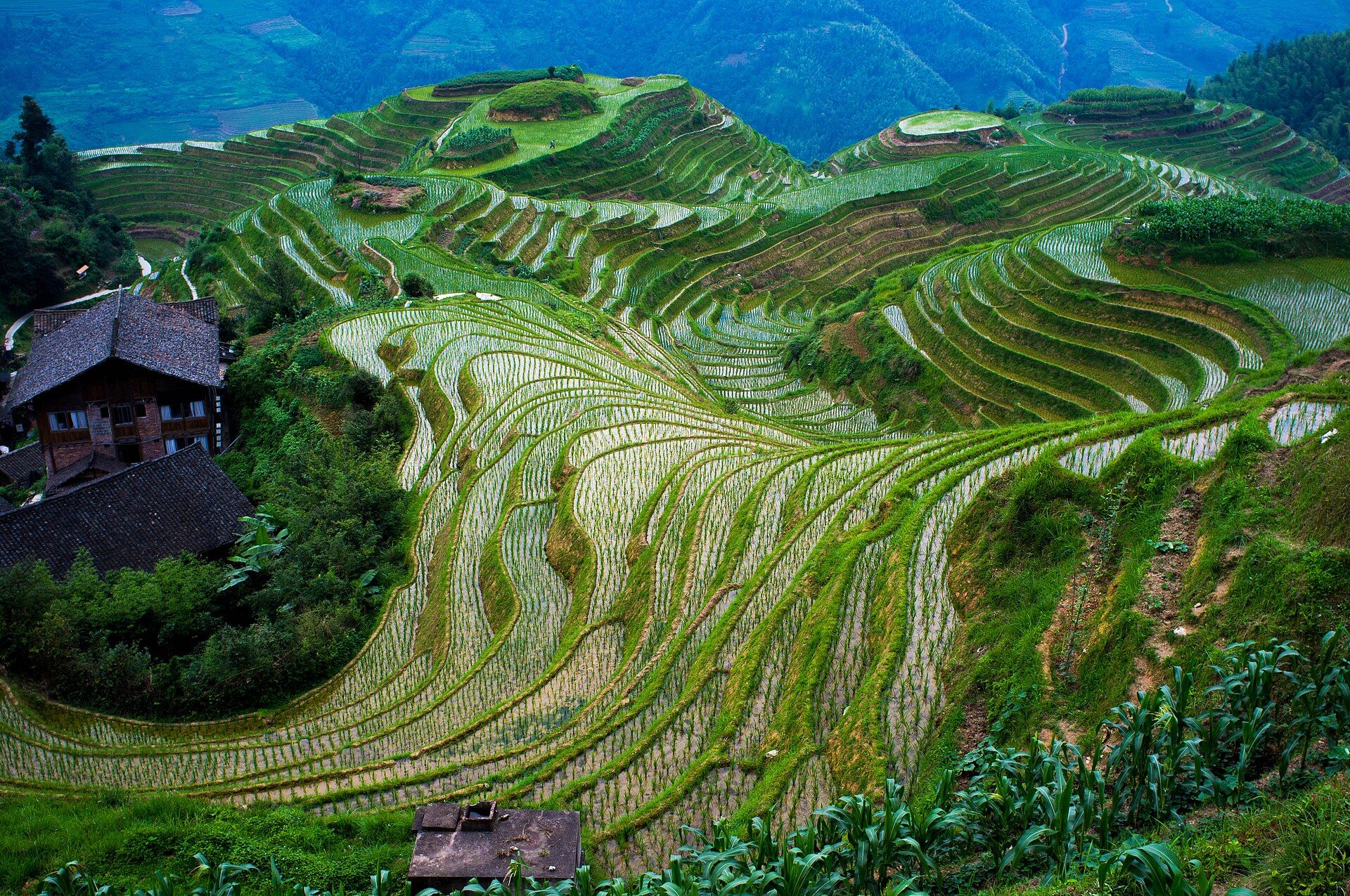
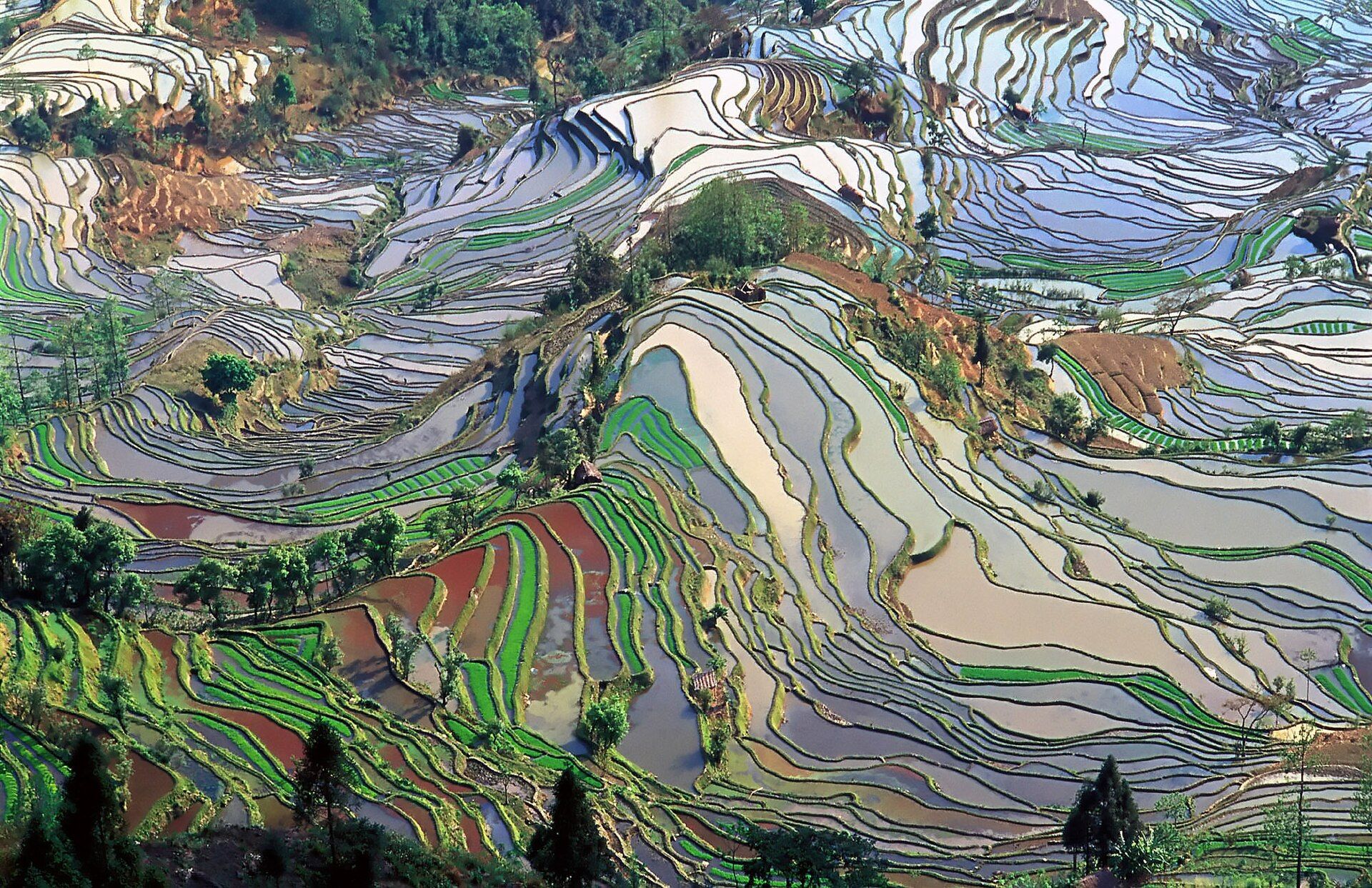
Thousands of hand-cut paddy terraces falling three thousand steps down the Ailao Mountains in southern Yunnan — flooded through the winter months into a vast staircase of mirrors that turns pink and gold at sunrise.
What makes it marvelous
The Honghe Hani terraces are the largest and most dramatic terraced landscape in China, and among the largest anywhere. Cut into the flanks of the Ailao Mountains above the Red River, they descend in as many as three thousand steps, at slopes ranging from a gentle fifteen degrees to a punishing seventy-five, across a landscape the Hani people have been shaping for roughly 1,300 years. The engineering is the marvel: forest is deliberately preserved on the ridge tops, where it condenses cloud and holds water, and a network of hand-dug channels carries that water down through village, terrace, and river in sequence, so the whole mountainside functions as one irrigation system. UNESCO inscribed 16,603 hectares of it in 2013. Because the fields lie flooded through the cool months rather than the summer, Yuanyang's signature season is winter, when tier upon tier of still water catches the sky.
Why visit
This is the terraced landscape at a scale nothing else quite matches — a mountainside of water that changes colour by the minute as the sun comes up, from steel grey through rose to molten orange, with the ridge forest floating above it in cloud. The viewpoints at Duoyishu, Bada, and Laohuzui each read the light differently, and the walk between villages puts you inside a working farm system rather than beside a monument.
Still deciding?
Yuanyang Rice Terraces comes up most often against these — each one weighs cost, effort, season and crowds side by side.
What to know before you go
🗓️ Best time
Roughly November to April, when the terraces are flooded and mirror the sky — December to March is the classic window. Sunrise and sunset are the point; the middle of the day flattens the reflections. Summer is green and lush but far less photogenic, and the mountain roads are wetter.
🧭 Getting there & access
Yuanyang is roughly 4–5 hours by road from Kunming, Yunnan's capital, usually via Jianshui. Buses and hired cars run to Xinjie, the hillside town most visitors base in, and a scenic-area ticket covers the main viewpoint platforms. The viewpoints are strung along mountain roads, so a car or a local driver makes a dawn start realistic.
Good to know
- Base yourself in Xinjie or a terrace village and start before dawn — the reflections are gone within an hour or two of sunrise.
- Duoyishu is the classic sunrise viewpoint; Laohuzui works better for sunset.
- Come between November and April if you want the flooded mirrors — a summer visit is a green, entirely different place.
- Mountain fog is common and can cancel a sunrise outright; allow more than one morning.
Plan your visit
Easy🧭 Getting there
From Kunming (KMG), Yunnan, China
- Fly or take the high-speed train into Kunming
- Travel about 4–5 hours by bus or hired car south to Yuanyang, often via Jianshui
- Base in Xinjie town or one of the terrace villages such as Duoyishu
- Drive out to the viewpoint platforms before first light
- Total travel
- A full day from Kunming; the terraces need at least two nights
- Time at site
- Two to three nights, to allow for fog spoiling a sunrise
- Access
- A scenic-area ticket covers the main viewpoints and is usually valid for several days. The terraces are working farmland — stay on the paths and field banks, and ask before photographing people at work.
🎒 What to bring & consider
- Warm layers — winter mornings at altitude are genuinely cold before sunrise
- A torch or headlamp for pre-dawn walks to the platforms
- Cash, as village guesthouses and small restaurants often take nothing else
- Shoes with grip for muddy, slippery field banks
- Patience for fog, which can hide the terraces for a whole morning
👁️ What to expect
- Crowds
- Photographers crowd the main sunrise platforms in season, sometimes shoulder to shoulder; walk ten minutes along the ridge and it thins out fast.
- Conditions
- Cool, damp and often foggy in the flooding season; narrow mountain roads between viewpoints; muddy paths in the terraces themselves.
- Facilities
- Simple guesthouses, homestays and restaurants in Xinjie and the larger villages; almost nothing at the viewpoints beyond parking.
- The view
- Still water at first light from Duoyishu, when the flooded tiers pick up the colour of the sky before the wind gets up and breaks the reflection.
Times and requirements are approximate and change with season, weather, and local rules — confirm permits, fares, and schedules with operators before you travel.
Natural riches of the area
- Around 16,603 hectares of hand-built terraces on the Ailao Mountain slopes
- Protected ridge-top forest that condenses cloud and feeds the whole system
- Gravity-fed channels carrying water through forest, village, terrace, and river
- Red rice and other traditional varieties still farmed on the terraces
- Carp and ducks raised in the flooded paddies alongside the rice
Local food
- Hani red rice
- The traditional grain of these terraces, nuttier and darker than lowland white rice.
- Paddy-raised fish
- Carp and loach reared in the flooded terraces themselves and cooked fresh.
- Yunnan wild mushrooms
- The province's forests yield an exceptional range of edible fungi in season.
- Hani long-table fare
- Communal village cooking built on cured pork, mountain vegetables, and chillies.
There is a moment at Yuanyang, perhaps twenty minutes long, when the whole mountainside turns to glass. In the cool months the Hani terraces lie flooded and unplanted, and thousands of stepped fields — descending in as many as three thousand tiers down the Ailao Mountains — hold the dawn sky one above another, so the slope reads as a staircase of coloured mirrors falling into cloud. Then the wind picks up, the surfaces ripple, and it is farmland again.
What holds it all together is water management, worked out and maintained over some thirteen centuries. Forest is kept deliberately intact along the ridge tops, where it strips moisture out of the near-permanent cloud; from there hand-dug channels lead the water down through the villages and then through terrace after terrace before it reaches the Red River far below. Nothing about the arrangement is accidental, and none of it is mechanised. UNESCO inscribed 16,603 hectares of the landscape in 2013, but the terraces are not a monument — they are still planted, still repaired by hand each season, and still growing the red rice that gave the system its reason to exist.
Yuanyang Rice Terraces: common questions
How do you get to Yuanyang Rice Terraces?
From Kunming (KMG), Yunnan, China: Fly or take the high-speed train into Kunming; Travel about 4–5 hours by bus or hired car south to Yuanyang, often via Jianshui; Base in Xinjie town or one of the terrace villages such as Duoyishu; Drive out to the viewpoint platforms before first light. Total travel time: A full day from Kunming; the terraces need at least two nights.
When is the best time to visit Yuanyang Rice Terraces?
Roughly November to April, when the terraces are flooded and mirror the sky — December to March is the classic window. Sunrise and sunset are the point; the middle of the day flattens the reflections. Summer is green and lush but far less photogenic, and the mountain roads are wetter.
How long should you spend at Yuanyang Rice Terraces?
Two to three nights, to allow for fog spoiling a sunrise. Total travel time: A full day from Kunming; the terraces need at least two nights.
What should you bring to Yuanyang Rice Terraces?
Warm layers — winter mornings at altitude are genuinely cold before sunrise A torch or headlamp for pre-dawn walks to the platforms Cash, as village guesthouses and small restaurants often take nothing else Shoes with grip for muddy, slippery field banks Patience for fog, which can hide the terraces for a whole morning
Do you need a permit or guide for Yuanyang Rice Terraces?
A scenic-area ticket covers the main viewpoints and is usually valid for several days. The terraces are working farmland — stay on the paths and field banks, and ask before photographing people at work.
Is Yuanyang Rice Terraces crowded, and what are conditions like?
Photographers crowd the main sunrise platforms in season, sometimes shoulder to shoulder; walk ten minutes along the ridge and it thins out fast. Cool, damp and often foggy in the flooding season; narrow mountain roads between viewpoints; muddy paths in the terraces themselves. Facilities: Simple guesthouses, homestays and restaurants in Xinjie and the larger villages; almost nothing at the viewpoints beyond parking.
Added
More wonders to explore