Moray
📍 Maras district, Sacred Valley, Cusco Region, Peru
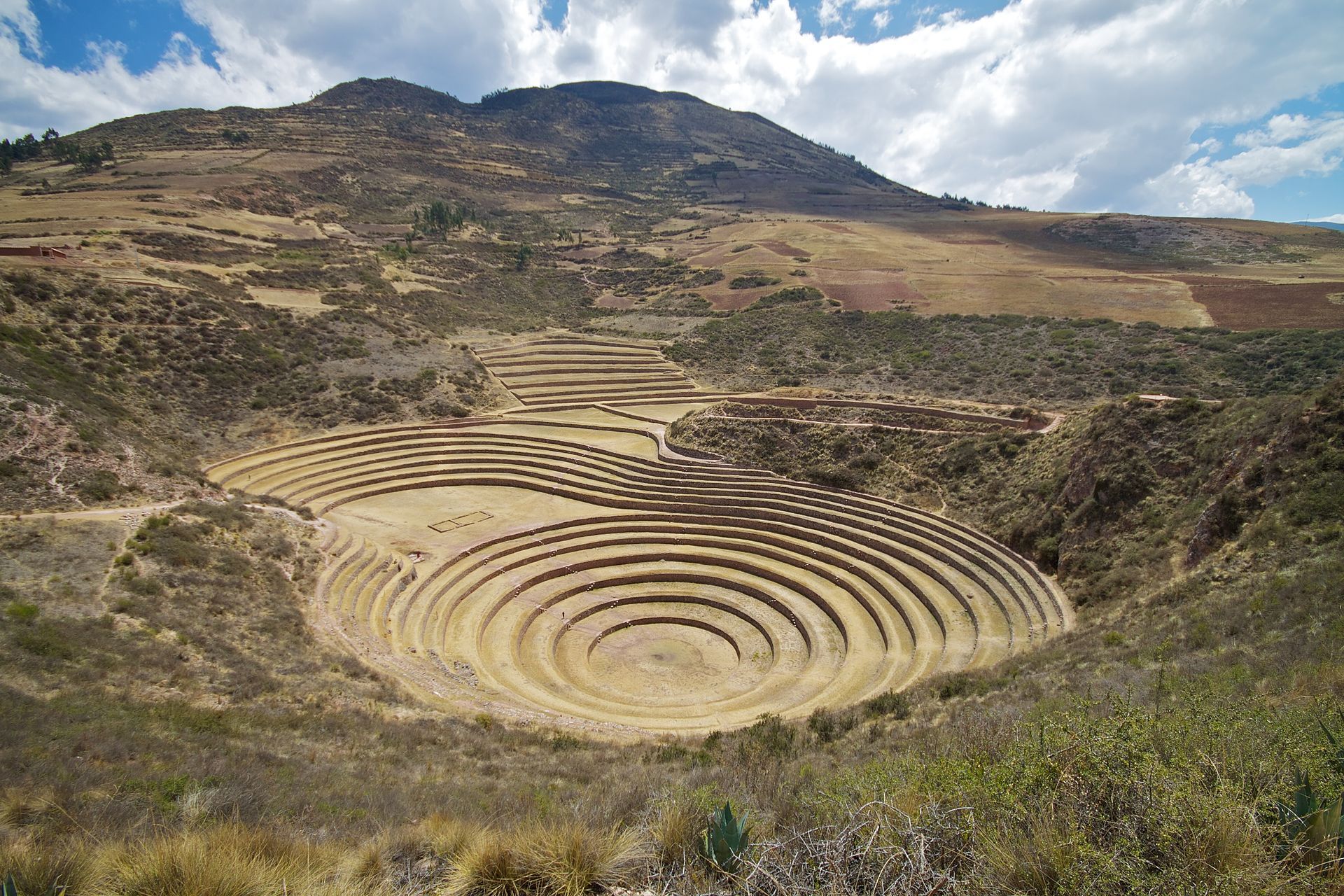
A set of vast concentric terraces sunk into the Andean plateau above the Sacred Valley — engineered bowls in which the temperature drops measurably from the top ring to the floor, giving Inca farmers a whole ladder of climates in one field.
What makes it marvelous
Moray looks like an amphitheatre and behaves like a laboratory. Three natural depressions in the limestone plateau were shaped into rings of dry-stone terracing, the largest bowl some 45 to 65 metres across and around 30 metres deep from rim to floor, with individual retaining walls three to five metres high. Because cold air pools at the bottom while the upper rings catch far more sun, researchers have measured differences of roughly 12 to 15°C between the highest and lowest terraces — the equivalent, in the Andes, of moving through several distinct altitude zones without leaving the site. Excavation has shown the terraces were filled with imported soils and given deep gravel drainage, so they shed the heavy Andean rain rather than waterlogging. The working conclusion is that Inca agronomists used the bowls to test how maize, potatoes, quinoa and other staples performed across temperature and moisture combinations, then applied what they learned across an empire spanning enormous variation in altitude.
Why visit
It is the rare archaeological site that is genuinely beautiful as pure geometry — perfect nested circles cut into an otherwise empty plateau at 3,500 metres, with the snow line of the Urubamba range on the horizon. It also rewards a slow look: once you know the temperature gradient is real and measurable, the rings stop being decorative and start reading as instrumentation.
What to know before you go
🗓️ Best time
The Andean dry season, roughly May to September, brings clear skies, cold nights and the most reliable footing. The wet season from December to March turns the access roads and terrace steps slippery, though the plateau is at its greenest. Mornings are calmest; afternoon wind is common year-round.
🧭 Getting there & access
Moray sits about 50 km from Cusco, roughly 1.5 hours by road via Chinchero, and around 40 minutes from Urubamba in the Sacred Valley. Most visitors come by hired car, taxi or tour, usually paired with the Maras salt ponds nearby. Entry is by the regional Boleto Turístico rather than a standalone ticket.
Good to know
- Acclimatise in Cusco or the Sacred Valley for a day or two first — Moray sits at about 3,500 m.
- Pair it with the Maras salt evaporation ponds, about 20 minutes away on the same plateau.
- Descending into the bowls is restricted to protect the terraces; the rim circuit is where the geometry reads best anyway.
- Bring wind protection — the plateau is exposed and the wind rarely stops.
Plan your visit
Easy🧭 Getting there
From Cusco (CUZ), Peru
- Fly into Cusco and allow a day or two to acclimatise
- Drive about 1.5 hours via Chinchero, or 40 minutes up from Urubamba
- Walk the rim circuit of the main bowl
- Continue about 20 minutes to the Maras salt ponds
- Total travel
- A half-day trip from Cusco or the Sacred Valley
- Time at site
- 1–2 hours at Moray; half a day including Maras
- Access
- Entry is covered by the Cusco Boleto Turístico, sold as a full or partial circuit — buy it before you arrive. Access down into the terraces is restricted; the rim path is open.
🎒 What to bring & consider
- Time to acclimatise first — this is 3,500 m and altitude sickness is the usual problem here
- Strong sun protection; UV at this altitude is fierce even when the air is cold
- Windproof layers, as the plateau is exposed and often blustery
- Water, and cash for the Boleto and local transport
👁️ What to expect
- Crowds
- Busiest late morning when Sacred Valley tours arrive; early and late in the day it can be nearly empty.
- Conditions
- Open, treeless plateau with a gravel rim path. Cold mornings, strong sun by midday, persistent wind.
- Facilities
- Ticket booth, toilets and a few stalls at the entrance; nothing at the terraces themselves.
- The view
- Low side light early or late, when the shadow of each retaining wall picks out the concentric rings; midday sun flattens them.
Times and requirements are approximate and change with season, weather, and local rules — confirm permits, fares, and schedules with operators before you travel.
Natural riches of the area
- Three engineered terrace bowls with a measured 12–15°C top-to-bottom temperature gradient
- Deep gravel drainage layers beneath imported agricultural soils
- The high limestone plateau above the Urubamba valley at around 3,500 m
- Andean crop diversity — hundreds of potato and maize varieties still farmed regionally
Local food
- Papas nativas
- Native Andean potatoes in dozens of shapes and colours, often served simply boiled.
- Choclo con queso
- Large-kernelled Sacred Valley maize eaten with fresh cheese.
- Sal de Maras
- Pink salt hand-harvested from the terraced evaporation ponds a short drive away.
- Chicha de jora
- A lightly fermented maize drink long made throughout the Andean highlands.
From the rim, Moray reads as pure geometry: nested rings of dry-stone terracing sunk into an otherwise featureless plateau at 3,500 metres, the largest of them dropping some thirty metres from the top ring to the floor. It is one of the few places where Inca engineering is legible at a glance, because the shape itself is the argument.
The bowls are not decorative. Cold air sinks and settles on the floor while the upper rings take far more sun, and the difference between the highest and lowest terraces has been measured at roughly 12 to 15°C — in Andean terms, a span of several distinct growing zones stacked inside a single field. Dig into the terraces and the design goes further: imported soils laid over deep gravel drainage, so that the heavy wet-season rain runs away instead of drowning the roots. The reasonable reading is that this was a working agricultural station, a place to find out which varieties of maize, potato and quinoa tolerated which conditions, in an empire that stretched from coastal desert to high puna. Whether or not every detail of that interpretation holds, the physics of the site is straightforward and still demonstrable with a thermometer.
Moray: common questions
How do you get to Moray?
From Cusco (CUZ), Peru: Fly into Cusco and allow a day or two to acclimatise; Drive about 1.5 hours via Chinchero, or 40 minutes up from Urubamba; Walk the rim circuit of the main bowl; Continue about 20 minutes to the Maras salt ponds. Total travel time: A half-day trip from Cusco or the Sacred Valley.
When is the best time to visit Moray?
The Andean dry season, roughly May to September, brings clear skies, cold nights and the most reliable footing. The wet season from December to March turns the access roads and terrace steps slippery, though the plateau is at its greenest. Mornings are calmest; afternoon wind is common year-round.
How long should you spend at Moray?
1–2 hours at Moray; half a day including Maras. Total travel time: A half-day trip from Cusco or the Sacred Valley.
What should you bring to Moray?
Time to acclimatise first — this is 3,500 m and altitude sickness is the usual problem here Strong sun protection; UV at this altitude is fierce even when the air is cold Windproof layers, as the plateau is exposed and often blustery Water, and cash for the Boleto and local transport
Do you need a permit or guide for Moray?
Entry is covered by the Cusco Boleto Turístico, sold as a full or partial circuit — buy it before you arrive. Access down into the terraces is restricted; the rim path is open.
Is Moray crowded, and what are conditions like?
Busiest late morning when Sacred Valley tours arrive; early and late in the day it can be nearly empty. Open, treeless plateau with a gravel rim path. Cold mornings, strong sun by midday, persistent wind. Facilities: Ticket booth, toilets and a few stalls at the entrance; nothing at the terraces themselves.
Added
More wonders to explore