Head to head · rice terraces
Yuanyang vs Banaue: Two Great Rice Terrace Landscapes Compared
Both are enormous hand-built terrace systems, both are UNESCO-inscribed, and both were made for the same reason: mountains too steep to farm and communities who needed to farm them anyway. But they look nothing alike in practice, and — crucially — they peak in opposite halves of the year.
Here is how Yunnan's Honghe Hani terraces and the Ifugao terraces around Banaue compare on scale, engineering, season, and how hard each is to reach.
Yuanyang
The flooded mirrors of Yunnan
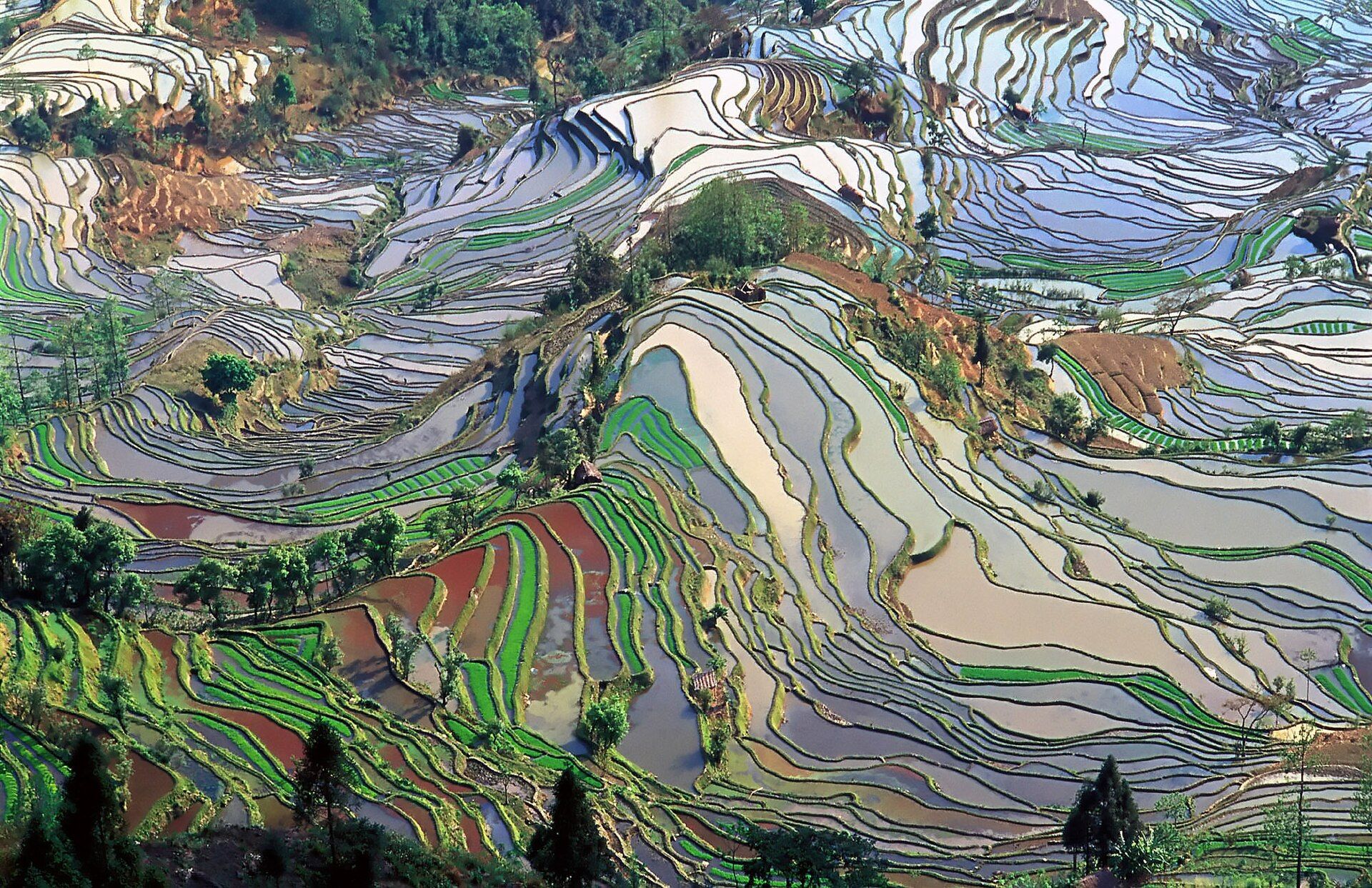
The Honghe Hani terraces fall down the Ailao Mountains in as many as three thousand steps, with 16,603 hectares inscribed by UNESCO in 2013. The Hani have worked them for roughly 1,300 years, keeping forest on the ridge tops to condense cloud and channelling that water down through village and terrace in sequence. Because the fields lie flooded through the cool months, the signature sight is winter — tier upon tier of still water catching the dawn.
- Vast scale — descending in as many as 3,000 steps
- The flooded winter mirrors are the defining image
- Multiple purpose-built sunrise and sunset viewpoints
- A whole mountainside functioning as one irrigation system
Banaue
The Ifugao terraces of the Cordilleras
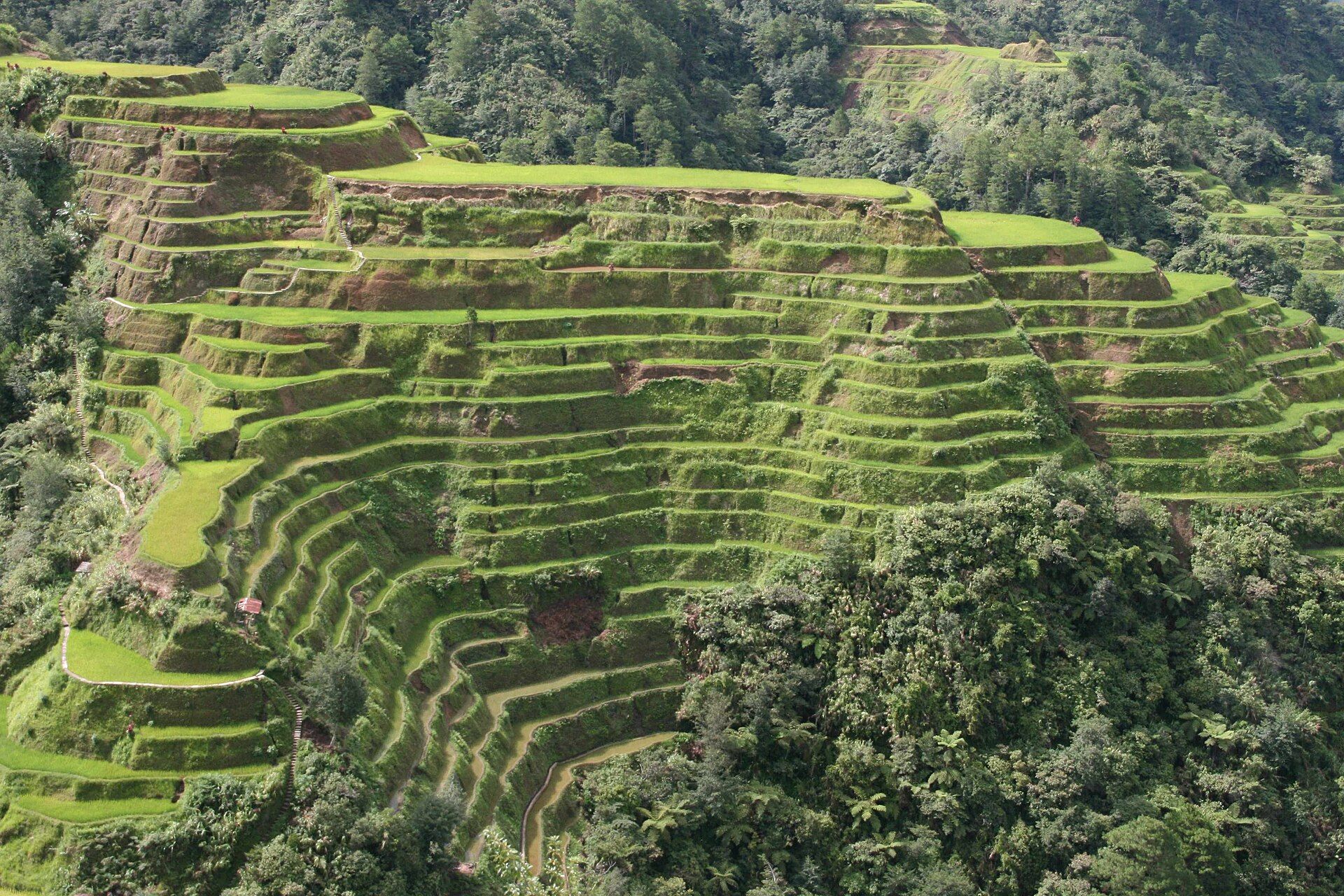
Carved into the steep Cordillera of northern Luzon and worked by the Ifugao for around two thousand years, these terraces are built with stone and mud walls following extremely sharp gradients, fed by an ancient system of channels from the rainforest above. The inscribed clusters — Batad's amphitheatre among them — are reached on foot, and the landscape is green rather than reflective for most of the year.
- Around two thousand years of continuous cultivation
- Extremely steep gradients, giving near-vertical stacked walls
- Batad's natural amphitheatre is a genuinely singular shape
- Reached on foot, so it feels earned rather than driven to
Head to head
| What matters | Yuanyang | Banaue |
|---|---|---|
| Scale Edge: Yuanyang | Far larger — 16,603 hectares inscribed, dropping in as many as 3,000 steps. | Smaller in inscribed area, but built on sharper gradients so the walls stack more steeply. |
| The signature look Edge: Toss-up | Flooded fields acting as mirrors, at their best from November to April. | Green terraced amphitheatres, greenest around the growing months and gold before harvest. |
| Best season Edge: Toss-up | Winter — roughly December to March for the reflections, the opposite of what most expect. | Roughly March to May for green growth, or the weeks before the harvest for gold. |
| Getting there Edge: Yuanyang | About 4–5 hours by road from Kunming, then short drives between viewpoints. | A long overnight bus from Manila, then jeepney and a walk in to the viewpoints. |
| Effort on the ground Edge: Yuanyang | Mostly viewpoint-based; you can see the best of it without a hard walk. | Genuinely physical — the finest clusters need a descent and a climb back out. |
| How it feels Edge: Banaue | Photographic and organised, with platforms and crowds at sunrise. | Quieter and more intimate, with village homestays right among the fields. |
Which should you choose?
Choose Yuanyang if…
Photographers and anyone who wants the maximum spectacle for the least effort, especially in winter when the flooded terraces do something no other landscape does.
Choose Banaue if…
Travellers who want to walk into a working landscape, stay in the villages, and see terracing at its steepest — and who don't mind a long journey to get there.
The honest verdict
The seasons decide it more than anything else. Yuanyang is a winter destination and Banaue is not, so if your travel window is fixed, that may settle the question outright.
For pure visual drama, Yuanyang in the flooding season is the stronger of the two. For a sense of living inside a two-thousand-year-old landscape, Banaue is.
They also reward opposite temperaments — one is a viewpoint you drive to before dawn, the other a valley you climb down into and sleep in.
Wonders mentioned here
Added