Huanglong
📍 Sichuan Province, China
A valley paved with thousands of terraced travertine pools in gold, turquoise, and blue — a three-kilometre cascade of mineral basins climbing toward snow peaks.
What makes it marvelous
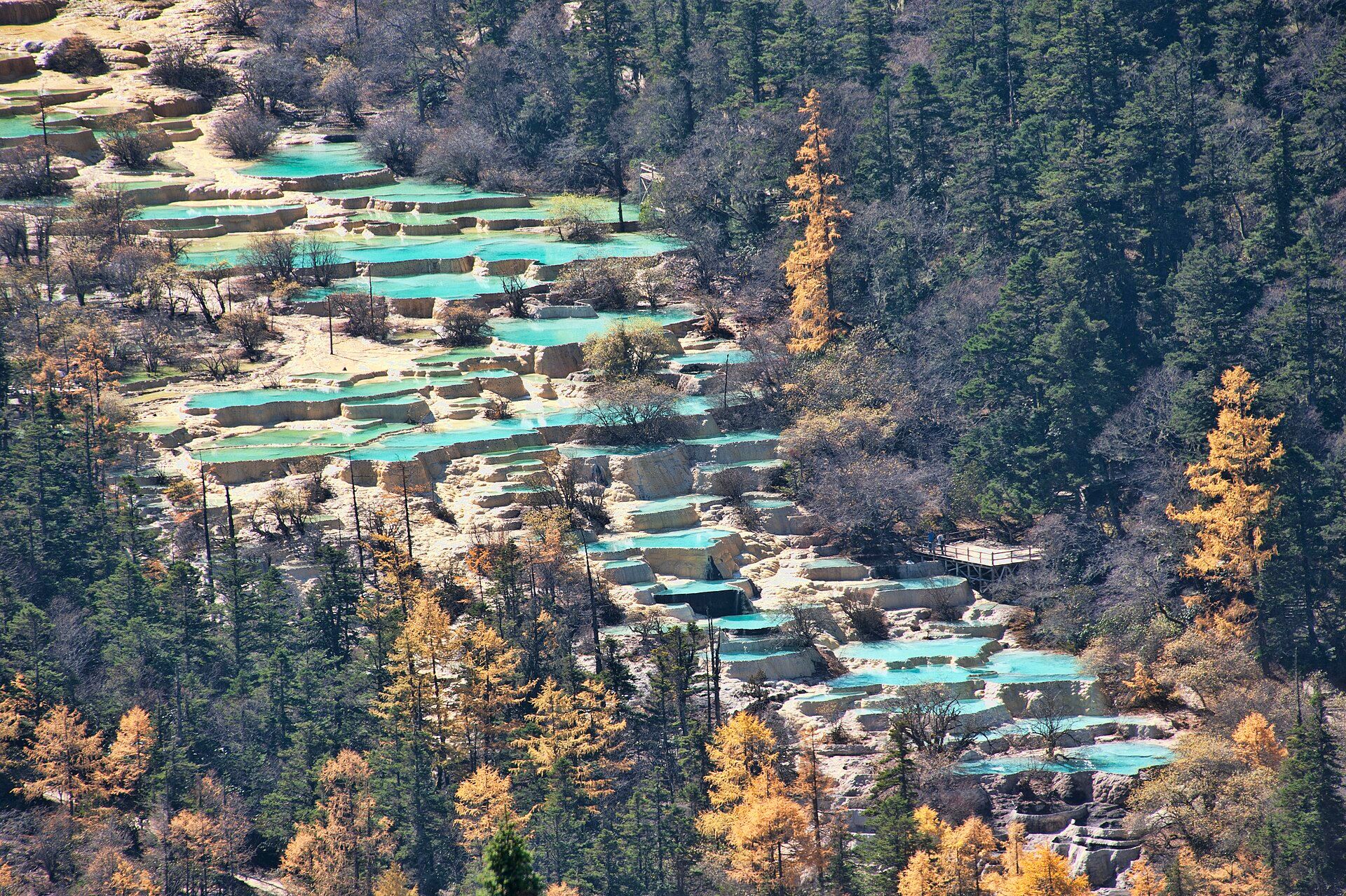
Huanglong — 'Yellow Dragon' — is named for the way its travertine formations ripple down the valley like the scaled back of a dragon. Calcium-rich water emerging from the mountains loses carbon dioxide as it flows and cools, depositing calcium carbonate that has built, over millennia, more than 3,000 terraced pools stepping some three kilometres up the valley. The mineral rims glow gold and ochre, while the still water within them shows in astonishing turquoise, blue, and green depending on depth, algae, and light. The highest pools sit above 3,500 metres, framed by snow-capped peaks and old-growth forest that shelters giant pandas and golden snub-nosed monkeys. Together with nearby Jiuzhaigou, it makes this corner of Sichuan one of the most scenically extraordinary regions in China. It is a UNESCO World Heritage Site.
Why visit
Climbing a boardwalk past thousands of gold-rimmed pools filled with impossibly coloured water, with snow peaks above, is one of the most surreal and beautiful walks anywhere in China.
Still deciding?
Huanglong comes up most often against these — each one weighs cost, effort, season and crowds side by side.
What to know before you go
🗓️ Best time
Autumn (roughly September–early November) for peak water colour and forest colour; late spring and summer are lush but wetter. The high valley is cold and often snowbound in winter.
🧭 Getting there & access
In northern Sichuan, near Jiuzhaigou and reached via Jiuzhai Huanglong Airport or a long drive from Chengdu; a boardwalk climbs the valley, with a cable car available for the ascent.
Good to know
- Take the cable car up and walk down — the top pools sit above 3,500 m.
- Come in autumn for the richest water and forest colour.
- Altitude is real here; ascend gently and allow time to acclimatize.
Plan your visit
Moderate🧭 Getting there
From Songpan / Huanglong, Sichuan, China
- Fly to Jiuzhai Huanglong airport (JZH), one of the highest airports in China
- Drive to the Huanglong scenic area — roughly 1h from the airport
- Walk or take the cable car and boardwalk up to the Five-Colour Pond — a climb to around 3,600m
- Total travel
- A flight plus a short transfer, often paired with Jiuzhaigou
- Time at site
- A full day on the boardwalks
- Access
- Huanglong is a ticketed scenic area, and the terraced travertine pools are reached by a long boardwalk climb, or a cable car plus a walk, up to the Five-Colour Pond at the top. Altitude is the catch: the airport is one of the highest in the world and the top pools sit near 3,600m, high enough that the climb leaves people breathless and occasionally ill — there are oxygen stations along the way for a reason. The pools are at their vivid best when full of water, in autumn especially; in the dry season or a hard freeze they can run dry or ice over. Check the season before planning around the colour.
🎒 What to bring & consider
- Respect for the altitude — the top pools are near 3,600m and even the boardwalk climb is hard work in thin air
- A slow pace and the option of the cable car, plus awareness of the oxygen stations placed along the route
- Warm layers, since it is cold up top even when the valley below is mild
- A visit timed for the water, because out of season the famous pools can be dry or frozen and colourless
- Sun protection for high-altitude glare that is stronger than the temperature suggests
👁️ What to expect
- Crowds
- Busy in the autumn colour season and Chinese holidays. The boardwalk can be a slow-moving line then.
- Conditions
- High, cold and bright, on a long stepped boardwalk that gains real altitude.
- Facilities
- Ticket area, cable car, oxygen stations and toilets on the route. Towns for lodging nearby.
- The view
- The tiers of blue-and-gold travertine pools stepping down the mountainside from above the Five-Colour Pond, at their most saturated in autumn sun with the pools brimming.
Times and requirements are approximate and change with season, weather, and local rules — confirm permits, fares, and schedules with operators before you travel.
Natural riches of the area
- Over 3,000 terraced travertine pools across ~3 km
- Calcium carbonate deposited from mineral-rich mountain water
- Turquoise and gold pools framed by snow peaks
- Old-growth forest sheltering giant pandas and snub-nosed monkeys
Local food
- Sichuan cuisine
- The bold, numbing-spicy cooking of the province.
- Tibetan highland fare
- Yak meat, butter tea, and barley from the surrounding highlands.
- Wild mountain mushrooms
- Foraged from the old-growth forests of northern Sichuan.
Huanglong means ‘Yellow Dragon,’ and the name fits: the travertine formations ripple down the valley like the scaled back of some enormous creature. Calcium-rich water emerges from the mountains, loses carbon dioxide as it flows and cools, and leaves behind calcium carbonate — a process that over millennia has built more than 3,000 terraced pools stepping roughly three kilometres up the valley floor.
The effect is astonishing. Mineral rims glow gold and ochre, while the still water they hold shows turquoise, deep blue, or green depending on depth, algae, and the angle of the light. The highest pools lie above 3,500 metres, framed by snow-capped peaks and old-growth forest that still shelters giant pandas and golden snub-nosed monkeys. Together with neighbouring Jiuzhaigou, this corner of Sichuan is among the most scenically extraordinary places in all of China.
Huanglong: common questions
How do you get to Huanglong?
From Songpan / Huanglong, Sichuan, China: Fly to Jiuzhai Huanglong airport (JZH), one of the highest airports in China; Drive to the Huanglong scenic area — roughly 1h from the airport; Walk or take the cable car and boardwalk up to the Five-Colour Pond — a climb to around 3,600m. Total travel time: A flight plus a short transfer, often paired with Jiuzhaigou.
When is the best time to visit Huanglong?
Autumn (roughly September–early November) for peak water colour and forest colour; late spring and summer are lush but wetter. The high valley is cold and often snowbound in winter.
How long should you spend at Huanglong?
A full day on the boardwalks. Total travel time: A flight plus a short transfer, often paired with Jiuzhaigou.
What should you bring to Huanglong?
Respect for the altitude — the top pools are near 3,600m and even the boardwalk climb is hard work in thin air A slow pace and the option of the cable car, plus awareness of the oxygen stations placed along the route Warm layers, since it is cold up top even when the valley below is mild A visit timed for the water, because out of season the famous pools can be dry or frozen and colourless Sun protection for high-altitude glare that is stronger than the temperature suggests
Do you need a permit or guide for Huanglong?
Huanglong is a ticketed scenic area, and the terraced travertine pools are reached by a long boardwalk climb, or a cable car plus a walk, up to the Five-Colour Pond at the top. Altitude is the catch: the airport is one of the highest in the world and the top pools sit near 3,600m, high enough that the climb leaves people breathless and occasionally ill — there are oxygen stations along the way for a reason. The pools are at their vivid best when full of water, in autumn especially; in the dry season or a hard freeze they can run dry or ice over. Check the season before planning around the colour.
Is Huanglong crowded, and what are conditions like?
Busy in the autumn colour season and Chinese holidays. The boardwalk can be a slow-moving line then. High, cold and bright, on a long stepped boardwalk that gains real altitude. Facilities: Ticket area, cable car, oxygen stations and toilets on the route. Towns for lodging nearby.
Added Updated
More wonders to explore