Head to head · Iceland's two great glacial-river waterfalls
Gullfoss vs Dettifoss: Which Iceland Waterfall Is Worth the Trip?
Gullfoss and Dettifoss are Iceland's two big glacial-river waterfalls, and they are often mentioned in the same breath. They are not neighbours. Gullfoss is on the Golden Circle in the southwest, about 1h45 by road from Reykjavík. Dettifoss is in the northeast, inside Vatnajökull National Park, and is usually reached from Mývatn or Akureyri.
So the real question is rarely which one to see on a given day. It is whether Dettifoss is worth building a northern leg into your trip, or whether Gullfoss on a Golden Circle day gives you enough of the same thing.
Gullfoss
Two tiers and a rainbow, an easy day from Reykjavík
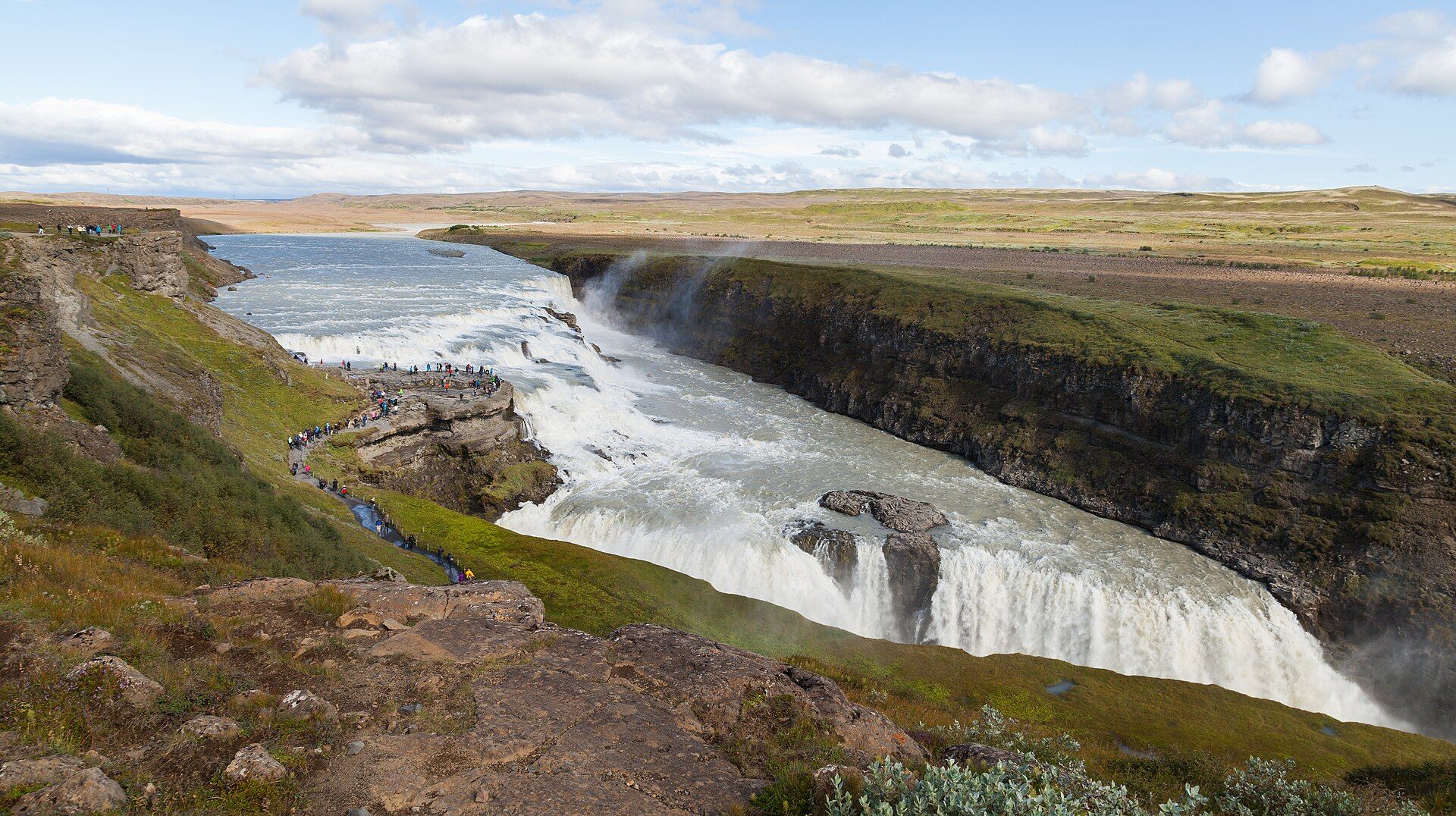
The Hvítá river, fed by the Langjökull ice cap, drops about 32 metres in two stepped tiers set at right angles, into a canyon cut through lava and glacial sediment. In summer the flow averages well over 100 cubic metres a second, and sunny days bring rainbows in the spray. It is free, with a visitor centre, café and toilets at the upper car park, and it sits 10 minutes from Geysir on the Golden Circle loop.
- Under two hours from Reykjavík and open all year
- The stepped, right-angled double drop, which is the more photogenic shape
- Visitor centre, café and toilets on site, and Geysir and Þingvellir on the same loop
Dettifoss
Europe's most powerful waterfall, in a black-basalt canyon
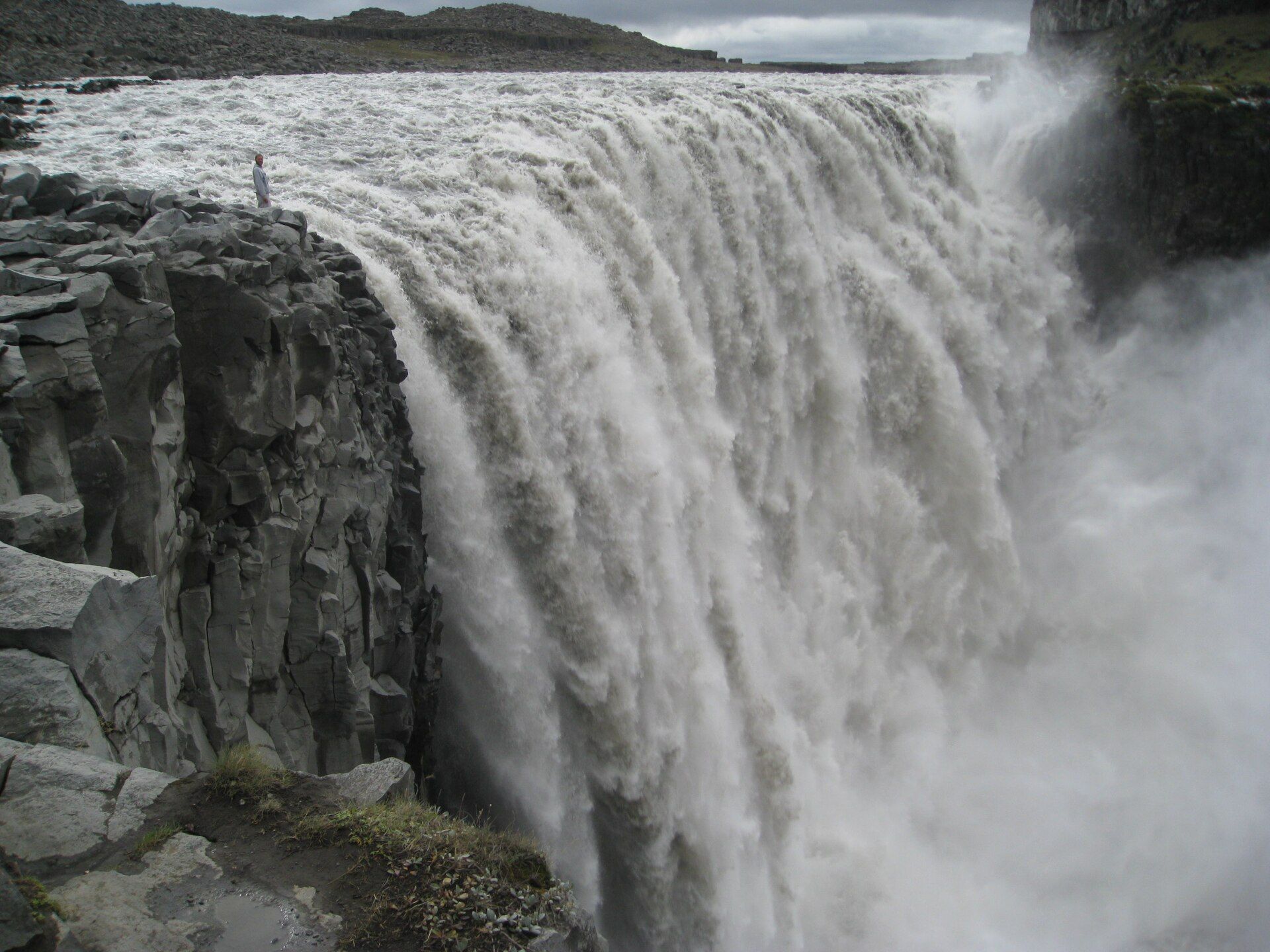
The Jökulsá á Fjöllum carries meltwater and rock flour off Vatnajökull and drops 44 metres over a lip about 100 metres wide, with an average flow of roughly 200 cubic metres a second. That is why it is commonly called the most powerful waterfall in Europe. The water is slate-grey and the canyon black. Paved road 862 serves the west bank and gravel road 864 the east bank; the two sides are not connected at the falls, and both roads are seasonal.
- Raw power: a wider, taller drop with roughly twice the average flow
- Selfoss upstream and Hafragilsfoss downstream on the same river
- Quieter than Gullfoss, especially from the east bank
Head to head
| What matters | Gullfoss | Dettifoss |
|---|---|---|
| The waterfall itself Edge: Dettifoss | About 32 m in two tiers at right angles. Shapely, bright when the sun is out, and easy to take in from the platforms. | 44 m high and about 100 m wide, grey and heavy. Less pretty, far more overwhelming, and you feel it through the ground. |
| Getting there Edge: Gullfoss | About 1h45 by road from Reykjavík, 10 minutes from Geysir, then a 5–15 minute walk from the car park. Free. | In the northeast: roughly 1–1h30 from Mývatn and a full day trip from Akureyri, then a 10–20 minute walk from each car park. |
| Season Edge: Gullfoss | Open all year. The lower path along the lip closes when icy, which is most of the winter, leaving the upper viewpoint. | Best June to early September. The access roads are usually closed or unsafe with snow and mud outside summer, and opening dates vary year to year. |
| Effort on site Edge: Gullfoss | Easy. Short paths and steps to the platforms, wet from spray. | Moderate. Short but uneven walks on wet basalt; the east bank is rougher and closer to the edge. |
| Facilities Edge: Gullfoss | Visitor centre with café, shop and toilets. | Car parks and toilets only; services are sparse in the northeast, so arrive with fuel and food. |
| Crowds Edge: Dettifoss | Busy at midday with Golden Circle coaches; much quieter early, late and in winter. | Busy in July and August on the paved west side; the east bank is quieter. |
| Photography Edge: Toss-up | The two-stage drop into the canyon with a rainbow, which needs afternoon sun from the right angle. In winter, the ice along the rim. | The full width from the west-bank viewpoint with a person for scale; late-evening northern sun through the spray. |
Which should you choose?
Choose Gullfoss if…
…you are based in Reykjavík, have only a few days, are visiting outside summer, or want a waterfall you can pair with Geysir and Þingvellir in one easy day.
Choose Dettifoss if…
…you are driving the full Ring Road or spending time around Mývatn between June and early September, and you want the most powerful waterfall in Europe rather than the prettiest.
The honest verdict
If your trip stays in the southwest, Gullfoss is the answer, and it is good enough on its own. Do not drive to the northeast just for Dettifoss on a short trip.
If you are doing the Ring Road or visiting Mývatn in summer, see both: they feel completely different. Gullfoss is the shapely, rainbow-hung one; Dettifoss is the grey, thundering one, and it is the more memorable of the two for many people.
Outside summer, Dettifoss is often simply not reachable, so Gullfoss wins by default. At either, wear full waterproofs and check road conditions with the Icelandic road administration before you set out.
Wonders mentioned here
Added