Victoria Falls
📍 Zambezi River, Zimbabwe / Zambia border
Known locally as Mosi-oa-Tunya, 'the smoke that thunders' — the Zambezi River drops over a 1.7-kilometre-wide precipice to form the largest single sheet of falling water on Earth, wrapped in a self-made rainforest of spray.
What makes it marvelous
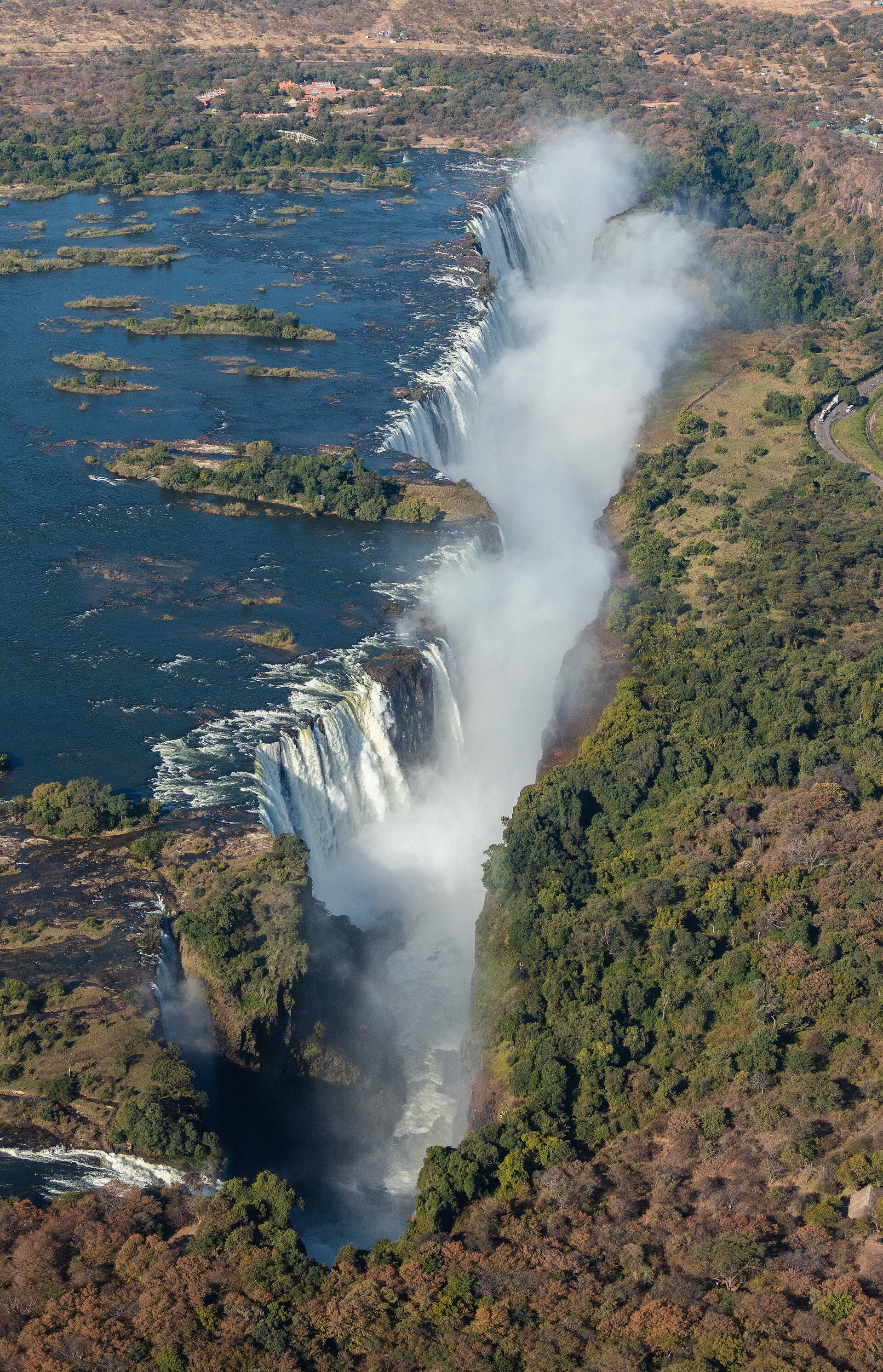
At peak flow the Zambezi pours over a basalt lip about 1,708 metres wide and up to 108 metres high, generating a curtain of water and a column of mist that can rise 400 metres and be seen from kilometres away. By the combined measure of width and height, it is the largest waterfall in the world. The perpetual spray waters a lush rainforest on the opposite cliff — an ecosystem that exists solely because of the falls — and a series of gorges records where the falls have retreated upstream over hundreds of thousands of years.
Why visit
The sight, sound, and drenching spray are overwhelming, and paths along the gorge rim lead you face-to-face with the curtain. In low water, the daring can even sit in the natural 'Devil's Pool' at the very edge. Rainbows (and lunar 'moonbows') arc constantly through the mist.
Still deciding?
Victoria Falls comes up most often against these — each one weighs cost, effort, season and crowds side by side.
More views of Victoria Falls
Additional photographs of the actual site — each freely licensed, with its photographer and licence credited.
What to know before you go
🗓️ Best time
February to May for maximum flow and the full 'smoke that thunders' spectacle (though heavy spray can obscure views); August to December for lower water, clearer views, and activities like Devil's Pool.
🧭 Getting there & access
Reached from Victoria Falls town (Zimbabwe) or Livingstone (Zambia), each with an airport; the two sides give different views and both are worth seeing across the border.
Good to know
- See both the Zimbabwean and Zambian sides for the full picture.
- Bring a rain jacket — the spray soaks the rim paths in high water.
- Devil's Pool is only safe in low-water season and only with licensed guides.
Plan your visit
Easy🧭 Getting there
From Victoria Falls (VFA), Zimbabwe or Livingstone (LVI), Zambia
- Fly Johannesburg to Victoria Falls or Livingstone — roughly 1h30–2h
- Airport to town — about 20–30 minutes
- Walk in from the park gate to the rainforest viewpoints
- Total travel
- Half a day via Johannesburg
- Time at site
- 2 days to see both the Zimbabwean and Zambian sides
- Access
- Separate national park entry on each side. Crossing the bridge between them is an international border — check visa requirements for your nationality, including whether you qualify for the KAZA UniVisa. Devil's Pool on the Zambian side only operates in the low-water months, and only through a licensed operator.
🎒 What to bring & consider
- A proper rain jacket — in high water the spray falls like heavy rain and ponchos at the gate barely help
- A dry bag or waterproof case; cameras and phones die here routinely
- Shoes with grip, because the paths stay permanently wet and slick
- Your passport if you intend to cross the bridge, even briefly
- Malaria prophylaxis advice from a travel clinic before you go
👁️ What to expect
- Crowds
- The Zimbabwe rainforest path is busy from mid-morning; first entry is much calmer. The Zambian side is generally quieter.
- Conditions
- Flat, well-made paths, but drenched and slippery in high water. The falls are loud enough to make conversation difficult.
- Facilities
- Good in both Victoria Falls town and Livingstone — hotels, food, operators, ATMs.
- The view
- Flow varies enormously across the year. Around March to May the falls are at maximum power but the spray can hide them completely; in the low months, roughly October to December, you see the rock face and far less water. Neither is the wrong time — decide which you want before booking.
Times and requirements are approximate and change with season, weather, and local rules — confirm permits, fares, and schedules with operators before you travel.
Natural riches of the area
- The Zambezi River and its vast catchment
- A permanent spray-fed rainforest and gorge ecosystems
- Abundant wildlife (elephants, hippos, birds) along the river
- Hydroelectric power downstream on the Zambezi
Local food
- Sadza
- The staple maize-meal porridge of Zimbabwe, eaten with stews and greens.
- Grilled river bream & kapenta
- Freshwater fish from the Zambezi, plus tiny dried kapenta fish.
- Biltong
- Air-dried, spiced cured meat, a Southern African snack.
The local name says it best: Mosi-oa-Tunya, ‘the smoke that thunders’. Where the wide Zambezi reaches a sudden basalt chasm, it collapses over a lip nearly 1.7 kilometres across, and the spray it throws up — visible from far off as a standing column of ‘smoke’ — waters a rainforest on the facing cliff that could exist nowhere else. By the combined measure of width and height, no waterfall on Earth drops a larger sheet of water.
Stand on the rim paths and the falls assault every sense: the roar, the trembling ground, the drenching mist, and rainbows (and on a full moon, rare ‘moonbows’) hanging in the spray. Downstream, a zig-zag of gorges marks where the falls have slowly eaten their way upstream over hundreds of thousands of years. Shared between Zimbabwe and Zambia, it rewards seeing from both banks — the same river, two utterly different views.
The local name, Mosi-oa-Tunya — “the smoke that thunders” — captures it better than the colonial one: the falls stretch more than 1,700 metres across and drop around 100 metres into a narrow gorge, throwing up a column of spray that can be seen from far off and soaks the rainforest along the rim. Flow swings dramatically with the seasons: it peaks in the months after the rains (roughly February to May), when the sheer volume can hide the falls in mist, while the low-water months open up rock and viewpoints. In that low season, and only then, the brave wade to Devil’s Pool on the Zambian side — a natural rock lip right at the edge of the drop. The falls are shared by Zimbabwe and Zambia, with a viewpoint-lined national park on each bank.
Victoria Falls: common questions
How do you get to Victoria Falls?
From Victoria Falls (VFA), Zimbabwe or Livingstone (LVI), Zambia: Fly Johannesburg to Victoria Falls or Livingstone — roughly 1h30–2h; Airport to town — about 20–30 minutes; Walk in from the park gate to the rainforest viewpoints. Total travel time: Half a day via Johannesburg.
When is the best time to visit Victoria Falls?
February to May for maximum flow and the full 'smoke that thunders' spectacle (though heavy spray can obscure views); August to December for lower water, clearer views, and activities like Devil's Pool.
How long should you spend at Victoria Falls?
2 days to see both the Zimbabwean and Zambian sides. Total travel time: Half a day via Johannesburg.
What should you bring to Victoria Falls?
A proper rain jacket — in high water the spray falls like heavy rain and ponchos at the gate barely help A dry bag or waterproof case; cameras and phones die here routinely Shoes with grip, because the paths stay permanently wet and slick Your passport if you intend to cross the bridge, even briefly Malaria prophylaxis advice from a travel clinic before you go
Do you need a permit or guide for Victoria Falls?
Separate national park entry on each side. Crossing the bridge between them is an international border — check visa requirements for your nationality, including whether you qualify for the KAZA UniVisa. Devil's Pool on the Zambian side only operates in the low-water months, and only through a licensed operator.
Is Victoria Falls crowded, and what are conditions like?
The Zimbabwe rainforest path is busy from mid-morning; first entry is much calmer. The Zambian side is generally quieter. Flat, well-made paths, but drenched and slippery in high water. The falls are loud enough to make conversation difficult. Facilities: Good in both Victoria Falls town and Livingstone — hotels, food, operators, ATMs.
Added Updated
More wonders to explore