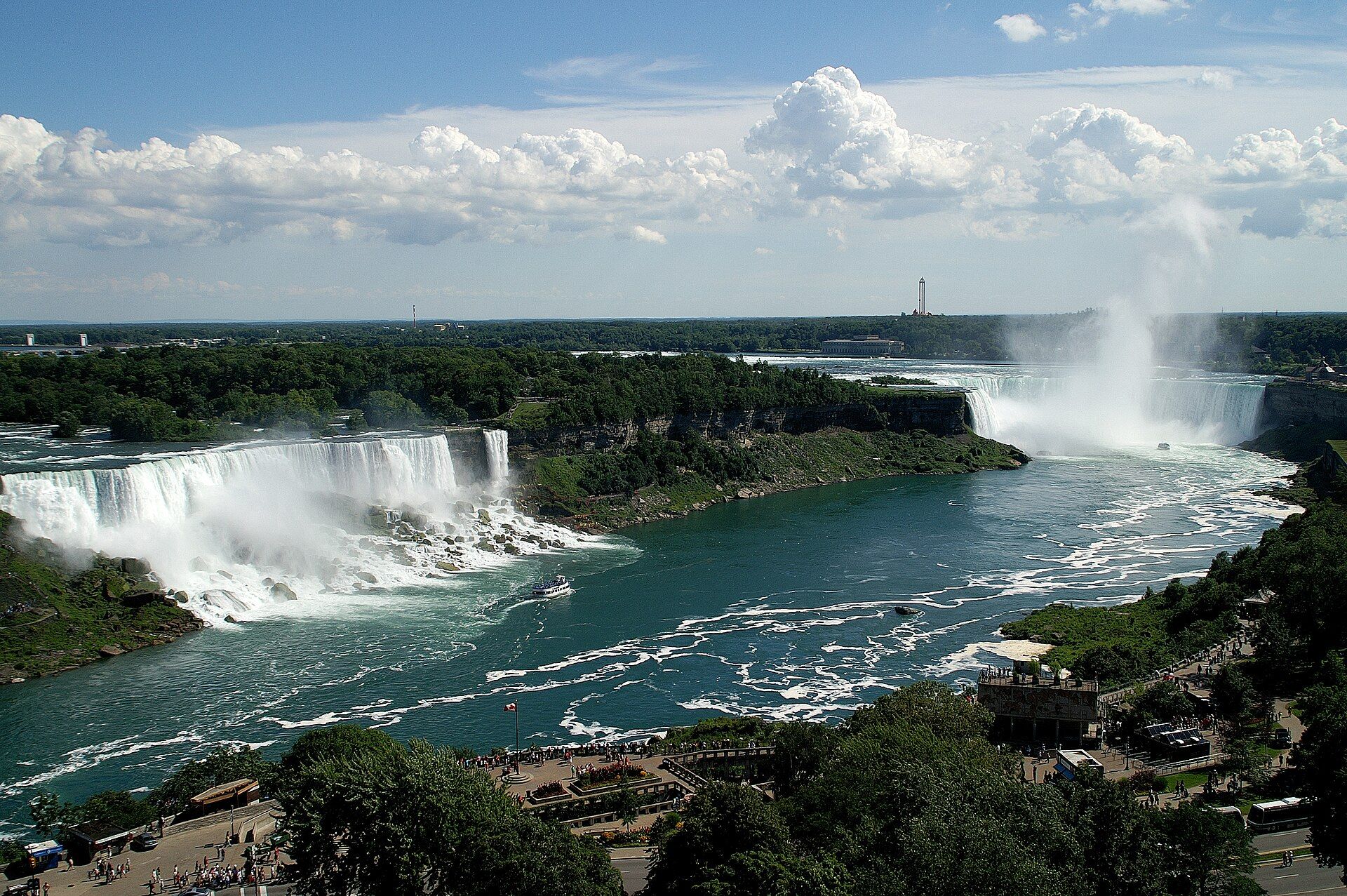
Niagara Falls
📍 Ontario, Canada / New York, United States
Not the tallest falls, but among the most powerful on Earth — three waterfalls on the Niagara River between the Great Lakes, where a colossal volume of water plunges over a cliff in a permanent roar of mist.
What makes it marvelous
Niagara carries the outflow of four of the five Great Lakes toward the Atlantic, so while the drop is only about 50 metres, the sheer volume is immense — on the order of thousands of cubic metres per second over the horseshoe-shaped Canadian falls alone. The falls formed as the river cut back through soft rock beneath a hard cap of dolostone, and they are still slowly eroding upstream. That same power made Niagara an early giant of hydroelectricity.
Why visit
The spectacle is visceral: the ground trembles, mist rises hundreds of metres, and boats nose right into the base of the Horseshoe Falls. Floodlights and fireworks light the cataract at night. It's one of the most accessible great natural wonders in North America.
Still deciding?
Niagara Falls comes up most often against these — each one weighs cost, effort, season and crowds side by side.
What to know before you go
🗓️ Best time
Late spring to early autumn for boat tours and full experiences; the falls run year-round and take on a frozen, ghostly beauty in deep winter.
🧭 Getting there & access
Straddling the Canada–US border between Ontario and New York, easily reached from Toronto or Buffalo. The Canadian side offers the panoramic Horseshoe view; boat tours run from both sides.
Good to know
- The Canadian (Ontario) side has the classic head-on Horseshoe Falls view.
- Take a boat tour to feel the power up close — you will get soaked.
- Stay well behind railings; the current above the falls is lethal.
Plan your visit
Easy🧭 Getting there
From Niagara Falls, Ontario, Canada
- Fly → Toronto (YYZ) or Buffalo (BUF)
- Drive or take the train/bus to Niagara Falls, Ontario — roughly 1h30 from Toronto
- Walk the falls promenade, and take the boat or the Journey Behind the Falls
- Total travel
- Around 90 minutes from Toronto
- Time at site
- A full day, or overnight for the illumination
- Access
- Niagara is the easy one — no permits, no wilderness, just a very accessible and very commercialised waterfall, with the Canadian side giving the head-on view of the Horseshoe Falls. The classic experiences are the boat trip (the Hornblower / Maid of the Mist) to the foot of the falls and the Journey Behind the Falls tunnels, both ticketed and both guaranteed to soak you in spray — ponchos are provided. The whole strip is busiest in summer and on holidays. The falls are lit in colour after dark and partly freeze into spectacular ice in deep winter.
🎒 What to bring & consider
- The acceptance that you will get wet on the boat and behind the falls, whatever the poncho promises
- A layer for the constant cold spray drifting off the falls, which chills even on a hot day at the railings
- Tickets for the boat and the tunnels booked or bought ahead in peak season to skip the longest queues
- An evening stay if you can, for the nightly illumination and the summer fireworks over the falls
- Sensible expectations about the surrounding strip, which is a loud, neon tourist circus by design
👁️ What to expect
- Crowds
- Heavy, especially in summer and on holidays. Early morning at the railings is the calm window.
- Conditions
- Wet with spray and easy underfoot, on paved promenades and built attractions.
- Facilities
- Complete — hotels, restaurants and attractions right at the falls. Everything is on hand.
- The view
- The Horseshoe Falls head-on from the Canadian promenade, with a rainbow in the spray on a sunny afternoon, or the coloured illumination and fireworks after dark. The boat deck gives the drenched, roaring, up-close version.
Times and requirements are approximate and change with season, weather, and local rules — confirm permits, fares, and schedules with operators before you travel.
Natural riches of the area
- The Niagara River draining four of the five Great Lakes
- Massive, reliable hydroelectric power
- The Niagara Gorge and its rare ecosystems
- Fertile fruit-and-wine country along the river
Local food
- Icewine
- The Niagara region is world-famous for sweet wine made from frozen grapes.
- Peaches & tender fruit
- The Niagara Peninsula is a celebrated fruit-growing belt.
- Poutine
- The Canadian classic — fries, cheese curds, and gravy.
Niagara doesn’t impress with height — the drop is only about 50 metres — but with sheer, relentless power. The Niagara River carries the combined outflow of four of the five Great Lakes toward the sea, and where it pours over the Horseshoe Falls, thousands of cubic metres of water fall every second, throwing up mist you can see from far off and feel on your skin at the rim.
The falls exist because the river has been cutting backward through soft rock beneath a hard limestone cap for thousands of years, and they are still slowly migrating upstream. That same immense flow made Niagara a cradle of hydroelectric power. Boats nudge into the base of the Horseshoe, floodlights colour the water at night, and the whole scene manages to feel both touristy and genuinely awesome. Just respect the river above the falls — its calm surface hides a deadly current.
Two things surprise first-time visitors. The first is how much of Niagara is switched off: under the 1950 Niagara Treaty water is diverted to hydroelectric stations on both banks, and the flow over the falls is only guaranteed to stay above about 2,832 cubic metres per second during tourist-season daylight — roughly half that at night and through the winter. The second is how fast the falls move. The Horseshoe crest retreated on the order of 1.7 metres a year through the nineteenth century; with much of the flow now diverted it erodes far more slowly, on the order of a third of a metre. The gorge downstream is the receipt — some eleven kilometres of it, cut since the ice sheets withdrew about twelve thousand years ago. And for the view, the Canadian bank genuinely is the better one: it faces the Horseshoe, while the American side stands alongside it.
Niagara Falls: common questions
How do you get to Niagara Falls?
From Niagara Falls, Ontario, Canada: Fly → Toronto (YYZ) or Buffalo (BUF); Drive or take the train/bus to Niagara Falls, Ontario — roughly 1h30 from Toronto; Walk the falls promenade, and take the boat or the Journey Behind the Falls. Total travel time: Around 90 minutes from Toronto.
When is the best time to visit Niagara Falls?
Late spring to early autumn for boat tours and full experiences; the falls run year-round and take on a frozen, ghostly beauty in deep winter.
How long should you spend at Niagara Falls?
A full day, or overnight for the illumination. Total travel time: Around 90 minutes from Toronto.
What should you bring to Niagara Falls?
The acceptance that you will get wet on the boat and behind the falls, whatever the poncho promises A layer for the constant cold spray drifting off the falls, which chills even on a hot day at the railings Tickets for the boat and the tunnels booked or bought ahead in peak season to skip the longest queues An evening stay if you can, for the nightly illumination and the summer fireworks over the falls Sensible expectations about the surrounding strip, which is a loud, neon tourist circus by design
Do you need a permit or guide for Niagara Falls?
Niagara is the easy one — no permits, no wilderness, just a very accessible and very commercialised waterfall, with the Canadian side giving the head-on view of the Horseshoe Falls. The classic experiences are the boat trip (the Hornblower / Maid of the Mist) to the foot of the falls and the Journey Behind the Falls tunnels, both ticketed and both guaranteed to soak you in spray — ponchos are provided. The whole strip is busiest in summer and on holidays. The falls are lit in colour after dark and partly freeze into spectacular ice in deep winter.
Is Niagara Falls crowded, and what are conditions like?
Heavy, especially in summer and on holidays. Early morning at the railings is the calm window. Wet with spray and easy underfoot, on paved promenades and built attractions. Facilities: Complete — hotels, restaurants and attractions right at the falls. Everything is on hand.
Added Updated
More wonders to explore