Hwange National Park
📍 Matabeleland North, north-western Zimbabwe, off the Bulawayo–Victoria Falls highway
Zimbabwe's largest national park: about 14,650 km² of grassland, teak and mopane woodland in the north-west, home to the country's biggest elephant population, painted dogs, roan and sable, and around 100 mammal species.
What makes it marvelous
Hwange is Zimbabwe's largest national park, covering about 14,650 km² of the country's north-west. Its landscape is mostly open savanna grassland broken by teak and mopane woodland, and it holds the largest population of elephants in Zimbabwe. Alongside elephant it has lion, leopard and buffalo — four of the 'big five' — as well as the endangered African wild dog (painted dog) and rarer antelope such as roan and sable. In all, about 100 mammal species and nearly 400 bird species have been recorded in the park, according to the Zimbabwe Parks and Wildlife Management Authority.
Why visit
Watch herds of elephants file down to drink at a waterhole as the light goes gold, then go looking for painted dogs, sable and lion across one of Southern Africa's great wilderness parks — a short drive from Victoria Falls.
What to know before you go
🗓️ Best time
The dry season, roughly July to October, when the bush thins and wildlife gathers at the remaining water, making animals far easier to find. The rainy months, roughly November to March, turn the park green and scatter game away from the waterholes.
🧭 Getting there & access
Main Camp, the principal entrance, lies 23 km off the Bulawayo–Victoria Falls highway at Cross Mabale — 283 km from Bulawayo or 172 km from Victoria Falls, all on tar. Robins Camp in the north-west is reached from Victoria Falls via the Pandamatenga turn-off. The nearest international airport is Victoria Falls; Main Camp has an airstrip for charter aircraft (prior permission to land required).
Good to know
- Malaria is present — take advice on prophylaxis before you travel, as the park authority itself advises.
- Give elephants with calves a wide berth; ZimParks lists them as the park's main caution.
- Bring binoculars and a field guide or app — with nearly 400 bird species, the birding is as rewarding as the big game.
- Self-drivers should carry enough food for their stay; camps are linked by a road network, but supplies inside the park are limited.
Plan your visit
Easy🧭 Getting there
From Victoria Falls (VFA), Zimbabwe; or Bulawayo (BUQ) by road
- Fly to Victoria Falls, or travel to Bulawayo
- Drive the Bulawayo–Victoria Falls highway to the Cross Mabale turn-off — 172 km from Victoria Falls, or 283 km from Bulawayo
- Turn off and continue 23 km on tar to Main Camp
- For Robins Camp, leave the Victoria Falls road at the Pandamatenga turn-off instead
- Total travel
- About 195 km by road from Victoria Falls to Main Camp — allow roughly 2.5–3.5 hours depending on traffic and stops
- Time at site
- Two to four days for game drives across more than one section of the park
- Access
- Park entry and any activity or camping fees are paid to ZimParks — confirm current fees and conditions with ZimParks (zimparks.org.zw) before you go. Camps are interconnected by a road network. Charter aircraft can use the airstrip at Main Camp with prior permission, and there is a serviced airstrip at Robins Camp. Indicative budget only — costs depend on whether you self-drive and stay in park camps or book a private lodge or guided safari, so price the specific options before you commit.
🎒 What to bring & consider
- Malaria precautions, arranged with a travel clinic before departure
- Binoculars, a camera and a wildlife guidebook or app
- Enough food for your stay if you are self-catering in the park camps
- A first-aid kit and a torch
- Warm layers for early-morning drives in the cooler dry months
👁️ What to expect
- Crowds
- A very large park with visitors spread thinly; the most popular waterholes can draw several vehicles at the same sighting.
- Conditions
- Long game drives on dirt roads, dusty and hot in the late dry season, with chilly mornings in winter.
- Facilities
- ZimParks camps including Main Camp and Robins Camp, plus privately run lodges; bring what you need for self-catering.
- The view
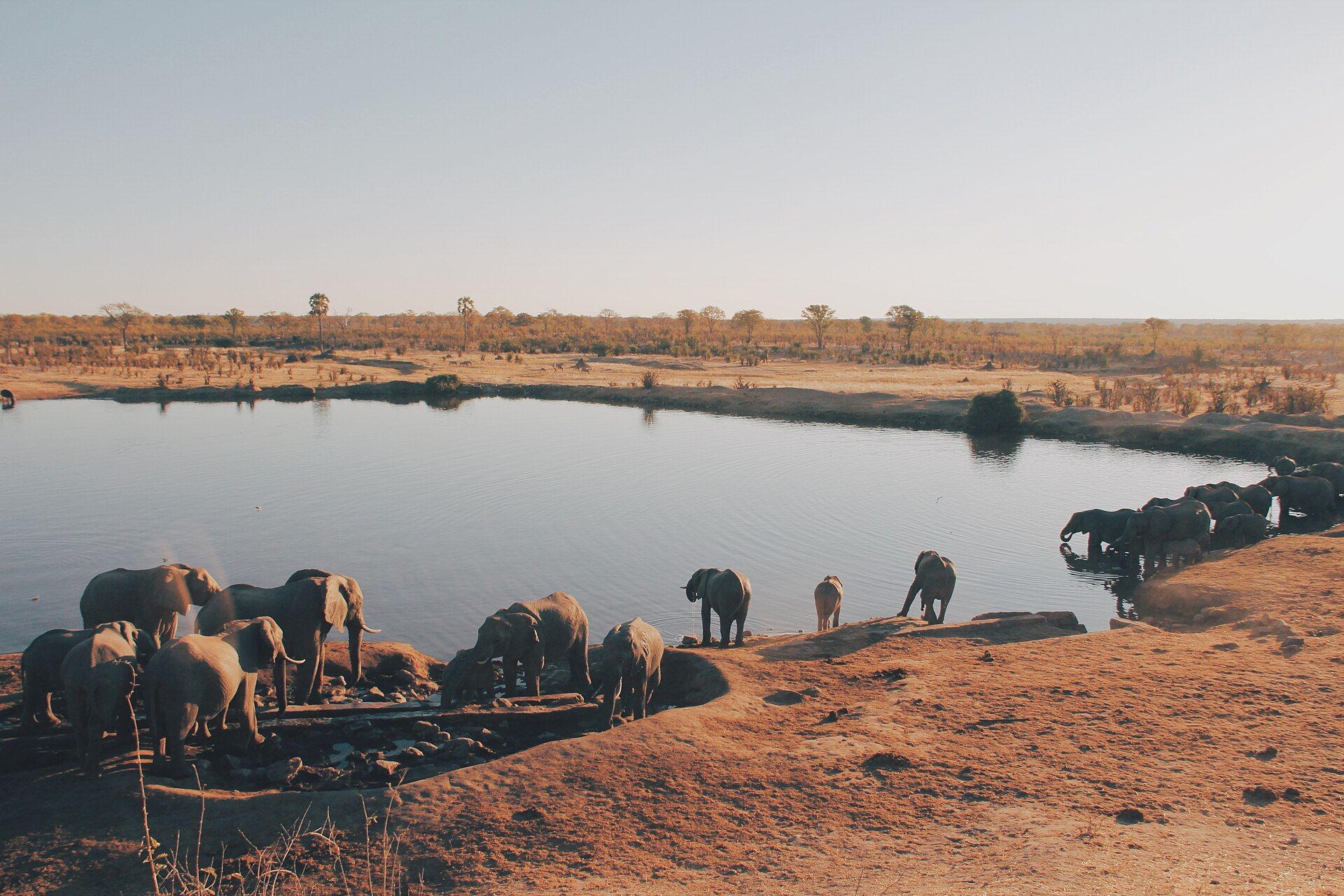
- A line of elephants drinking at a waterhole in low, late-afternoon light.
Times and requirements are approximate and change with season, weather, and local rules — confirm permits, fares, and schedules with operators before you travel.
Natural riches of the area
- Zimbabwe's largest elephant population
- Endangered African wild dogs, plus roan and sable antelope
- About 100 mammal species and nearly 400 bird species
- Savanna grassland with teak and mopane woodland
Local food
- Sadza (isitshwala)
- Zimbabwe's stiff maize-meal staple — called isitshwala in Ndebele-speaking Matabeleland — eaten with stews and greens.
- Mopane worms (amacimbi)
- Caterpillars gathered from mopane trees, dried and then fried or stewed — a seasonal favourite across Matabeleland.
Hwange is Zimbabwe’s biggest national park, spreading across about 14,650 square kilometres of the country’s north-west. Most of it is open savanna grassland, broken by stands of teak and mopane woodland, and it lies just off the main road between Bulawayo and Victoria Falls — close enough to the falls to pair the two on one trip.
Elephants are the headline. Hwange holds the largest elephant population in Zimbabwe, and in the dry season the herds come down to the waterholes to drink, often in long processions at the end of the day. Lion, leopard and buffalo complete four of the “big five”, and the park is also a stronghold of the endangered African wild dog, or painted dog, along with rarer antelope such as roan and sable. The Zimbabwe Parks and Wildlife Management Authority counts about 100 mammal species and nearly 400 bird species in the park.
Main Camp, the main entrance, sits 23 kilometres off the highway at Cross Mabale; Robins Camp, in the north-west, is reached from the Victoria Falls side. Come in the dry months, roughly July to October, when the bush thins and animals concentrate at the remaining water. Take malaria precautions, keep a respectful distance from elephants with calves, and confirm current fees with ZimParks before you set out.
Hwange National Park: common questions
How do you get to Hwange National Park?
From Victoria Falls (VFA), Zimbabwe; or Bulawayo (BUQ) by road: Fly to Victoria Falls, or travel to Bulawayo; Drive the Bulawayo–Victoria Falls highway to the Cross Mabale turn-off — 172 km from Victoria Falls, or 283 km from Bulawayo; Turn off and continue 23 km on tar to Main Camp; For Robins Camp, leave the Victoria Falls road at the Pandamatenga turn-off instead. Total travel time: About 195 km by road from Victoria Falls to Main Camp — allow roughly 2.5–3.5 hours depending on traffic and stops.
When is the best time to visit Hwange National Park?
The dry season, roughly July to October, when the bush thins and wildlife gathers at the remaining water, making animals far easier to find. The rainy months, roughly November to March, turn the park green and scatter game away from the waterholes.
How long should you spend at Hwange National Park?
Two to four days for game drives across more than one section of the park. Total travel time: About 195 km by road from Victoria Falls to Main Camp — allow roughly 2.5–3.5 hours depending on traffic and stops.
What should you bring to Hwange National Park?
Malaria precautions, arranged with a travel clinic before departure Binoculars, a camera and a wildlife guidebook or app Enough food for your stay if you are self-catering in the park camps A first-aid kit and a torch Warm layers for early-morning drives in the cooler dry months
Do you need a permit or guide for Hwange National Park?
Park entry and any activity or camping fees are paid to ZimParks — confirm current fees and conditions with ZimParks (zimparks.org.zw) before you go. Camps are interconnected by a road network. Charter aircraft can use the airstrip at Main Camp with prior permission, and there is a serviced airstrip at Robins Camp. Indicative budget only — costs depend on whether you self-drive and stay in park camps or book a private lodge or guided safari, so price the specific options before you commit.
Is Hwange National Park crowded, and what are conditions like?
A very large park with visitors spread thinly; the most popular waterholes can draw several vehicles at the same sighting. Long game drives on dirt roads, dusty and hot in the late dry season, with chilly mornings in winter. Facilities: ZimParks camps including Main Camp and Robins Camp, plus privately run lodges; bring what you need for self-catering.
Added
More wonders to explore
Amboseli National Park
Kajiado County, southern Kenya, on the Tanzanian border
Nxai Pan & Baines' Baobabs
Nxai Pan National Park, northeastern Botswana, north of the Maun–Nata road