The Li River
📍 Guilin to Yangshuo, Guangxi, Southern China
China's most famous river scene — a clear green waterway winding 83 kilometres from Guilin to Yangshuo through a forest of karst peaks, past bamboo groves, fishermen on rafts, and the misty limestone hills painted on the 20-yuan note.
What makes it marvelous
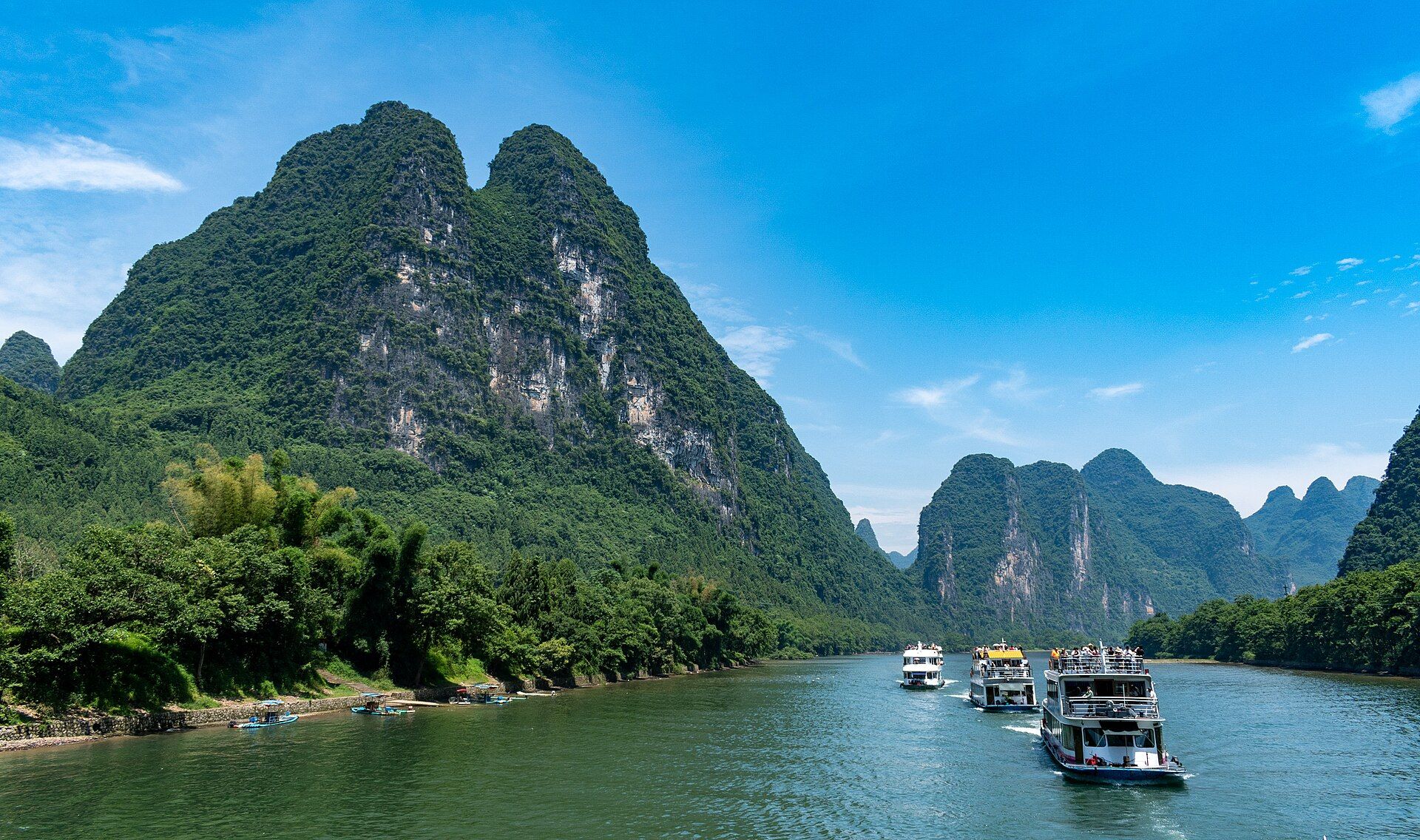
The stretch of the Li River from Guilin to Yangshuo is the landscape that stands for China itself — a clear, jade-green river curling for 83 kilometres between hundreds of steep, isolated karst peaks that rise straight from the water and the rice fields like a scattered forest of stone. Weathered from limestone over tens of millions of years, the hills crowd the riverbanks in receding ranks, softened by mist and reflected in the still water; ink painters and poets have drawn them for well over a thousand years. Water buffalo wade the shallows, cormorant fishermen pole bamboo rafts at dusk, and near Xingping the river bends past the exact array of peaks reproduced on the back of China's 20-yuan banknote. To drift this river is to move through the original of the classical Chinese scroll — 'a hundred-mile picture' of peaks, water, and mist.
Why visit
The Li River offers the definitive Chinese karst-and-water scenery: a slow cruise or bamboo-raft drift between hundreds of limestone peaks, the very view on the 20-yuan note, with cormorant fishermen, riverside villages, and Yangshuo's countryside at the end. It is one of the most beautiful and most painted river journeys in the world, easily reached from Guilin.
Still deciding?
The Li River comes up most often against one other place — each one weighs cost, effort, season and crowds side by side.
What to know before you go
🗓️ Best time
Best April to October, when water levels are high enough for the full cruise and the peaks are green; the misty, atmospheric scenes are common after rain in spring and early summer. Autumn brings clearer skies and comfortable temperatures.
🧭 Getting there & access
Cruises run from Guilin (or Mopanshan pier just south) down to Yangshuo, about 4–5 hours on the water. Bamboo rafts run shorter scenic stretches, such as Xingping to the 20-yuan viewpoint. Guilin has an airport and high-speed rail links.
Good to know
- For the 20-yuan-note view, take a raft or walk from Xingping rather than the full big-boat cruise.
- Travel after rain for the classic mist wrapping the peaks — the most painterly conditions.
- End in Yangshuo and cycle or raft the Yulong River backcountry among quieter karst hills.
Plan your visit
Easy🧭 Getting there
From Guilin (KWL), China
- Reach Guilin by air or high-speed rail
- Board a river cruise from Guilin/Mopanshan pier down to Yangshuo
- Or take a bamboo raft on the Xingping stretch for the 20-yuan viewpoint
- Total travel
- A full day for the Guilin–Yangshuo cruise; two or more days to add Yangshuo's countryside
- Time at site
- 4–5h for the full cruise; a half-day for a raft-and-viewpoint trip
- Access
- Cruises run year-round but depend on water levels — the full Guilin–Yangshuo route needs enough flow, best April–October. Big boats and rafts are regulated; book through licensed operators.
🎒 What to bring & consider
- Sun and rain protection — open decks are exposed in all weather
- Cash for rafts, snacks, and village stops
- A camera with a zoom for the receding peaks and fishermen
- Comfortable shoes for Xingping and Yangshuo walking
👁️ What to expect
- Crowds
- The big cruise boats run in convoys and Xingping's viewpoint is busy midday; early rafts and quieter stretches are calmer.
- Conditions
- Easy, comfortable boat travel; weather ranges from humid heat to atmospheric river mist and rain.
- Facilities
- Guilin, Xingping, and Yangshuo have full tourist services; the river itself has piers and raft landings.
- The view
- The tiered karst peaks near Xingping reflected in the calm river, a cormorant fisherman on a bamboo raft in the foreground.
Times and requirements are approximate and change with season, weather, and local rules — confirm permits, fares, and schedules with operators before you travel.
Natural riches of the area
- Clear, green karst-fed river water winding between limestone peaks
- Hundreds of weathered tower-karst hills rising from the river plain
- Riverside bamboo groves, rice fields, and caves in the limestone
- Fish supporting the region's traditional cormorant fishing
Local food
- Beer fish (píjiǔ yú)
- Yangshuo's signature dish — fresh Li River fish braised with local beer, tomato, and chilli.
- Guilin rice noodles
- The city's famous mǐfěn, rice noodles in savoury broth with pickles and crisp toppings.
- Stuffed Li River snails
- River snails stuffed with seasoned pork, a Guilin speciality.
The Li River between Guilin and Yangshuo is the landscape that has come to stand for China. For 83 kilometres a clear, jade-green river curls between hundreds of steep karst peaks that rise straight out of the water and the rice fields like a scattered forest of stone — limestone towers weathered over tens of millions of years, crowding the banks in receding ranks and softened by mist. Ink painters and poets have drawn these hills for more than a thousand years, and near the village of Xingping the river bends past the exact array of peaks printed on the back of China’s 20-yuan banknote.
To drift the river is to travel through the original of the classical Chinese scroll: water buffalo wading the shallows, cormorant fishermen poling bamboo rafts at dusk, bamboo groves and small villages beneath the crowding peaks, all reflected in the still green water. The scene is best after rain, when cloud wraps the summits and the hills fade into one another in soft grey layers. Whether seen from the deck of a slow cruise boat or a bamboo raft on the Xingping stretch, the Li River is one of the most beautiful and most painted river journeys on Earth — a hundred-mile picture of peaks, water, and mist.
The Li River: common questions
How do you get to The Li River?
From Guilin (KWL), China: Reach Guilin by air or high-speed rail; Board a river cruise from Guilin/Mopanshan pier down to Yangshuo; Or take a bamboo raft on the Xingping stretch for the 20-yuan viewpoint. Total travel time: A full day for the Guilin–Yangshuo cruise; two or more days to add Yangshuo's countryside.
When is the best time to visit The Li River?
Best April to October, when water levels are high enough for the full cruise and the peaks are green; the misty, atmospheric scenes are common after rain in spring and early summer. Autumn brings clearer skies and comfortable temperatures.
How long should you spend at The Li River?
4–5h for the full cruise; a half-day for a raft-and-viewpoint trip. Total travel time: A full day for the Guilin–Yangshuo cruise; two or more days to add Yangshuo's countryside.
What should you bring to The Li River?
Sun and rain protection — open decks are exposed in all weather Cash for rafts, snacks, and village stops A camera with a zoom for the receding peaks and fishermen Comfortable shoes for Xingping and Yangshuo walking
Do you need a permit or guide for The Li River?
Cruises run year-round but depend on water levels — the full Guilin–Yangshuo route needs enough flow, best April–October. Big boats and rafts are regulated; book through licensed operators.
Is The Li River crowded, and what are conditions like?
The big cruise boats run in convoys and Xingping's viewpoint is busy midday; early rafts and quieter stretches are calmer. Easy, comfortable boat travel; weather ranges from humid heat to atmospheric river mist and rain. Facilities: Guilin, Xingping, and Yangshuo have full tourist services; the river itself has piers and raft landings.
Added
More wonders to explore