Benagil Sea Cave
📍 Benagil, Algarve, southern Portugal
A domed sea cave on the Algarve coast whose vaulted limestone roof is pierced by a great circular skylight — an 'oculus' that pours a column of sunlight onto a hidden beach reachable only from the water.
What makes it marvelous
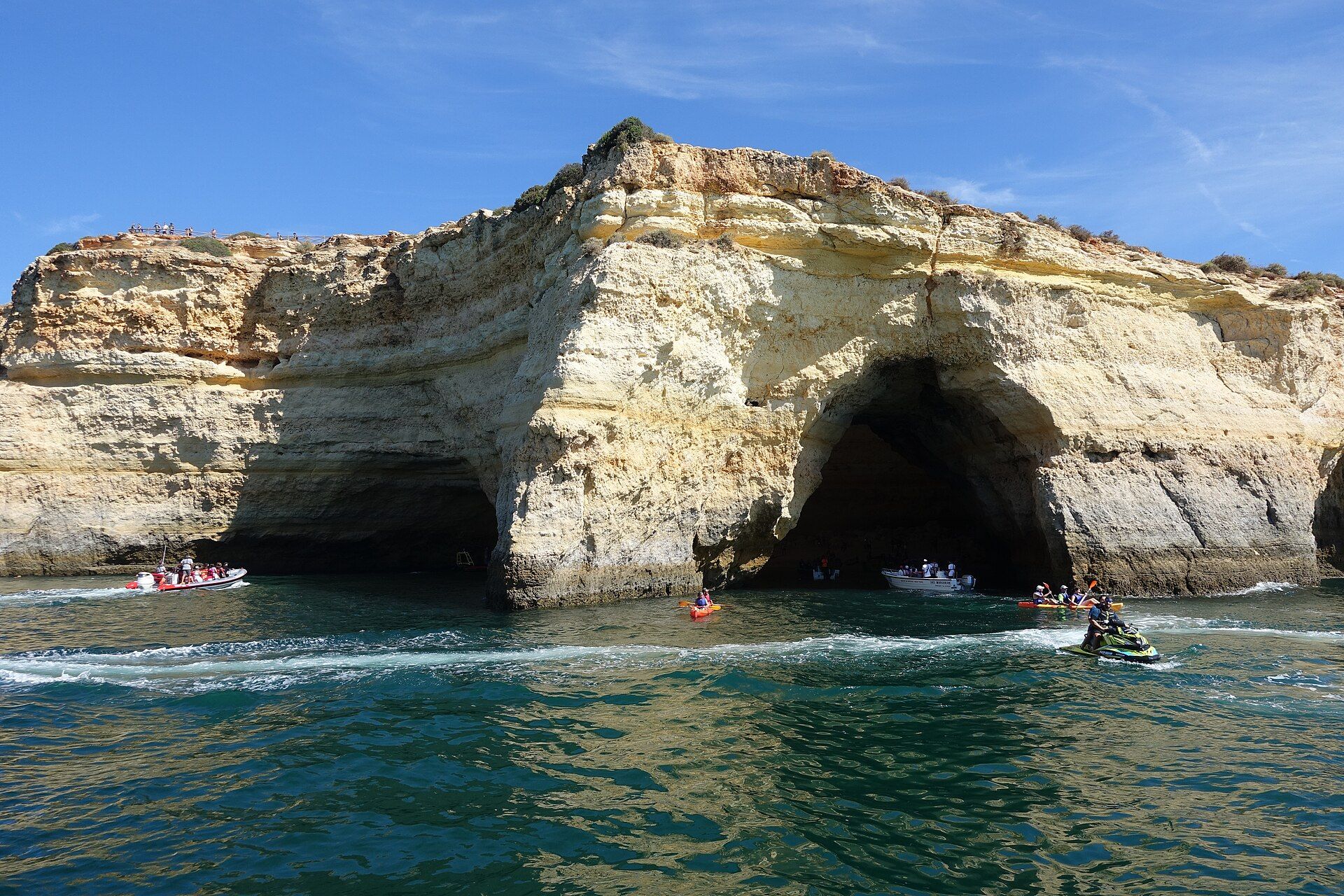
The Algarve's golden cliffs are soft Miocene limestone, roughly twenty million years old, and the Atlantic has spent millennia exploiting every crack in them. At Benagil the waves hollowed out a chamber with its own small sand beach, then the roof partly collapsed, leaving a near-perfect circular opening — the famous oculus — high in the domed ceiling. Through it a shaft of daylight falls onto the sand below, brightest in the morning hours when the sun sits at the right angle. Because the only natural entrances are at sea level, the beach inside can be reached only by swimming, kayaking, or boat — never overland — which is part of what has made it one of the most sought-after coastal sights in Europe.
Why visit
Drifting into the cavern from the sea and looking up as a column of sunlight streams through the roof onto the little beach is genuinely dreamlike — a natural cathedral sculpted by the ocean. Paddling the surrounding coast, threading between honey-coloured stacks and arches, is one of the finest sea-kayak outings anywhere in Portugal.
What to know before you go
🗓️ Best time
Late spring to early autumn (May–September) for calm seas and warm water; morning light gives the best beam through the oculus, and the sea must be settled enough for boats and kayaks to enter safely.
🧭 Getting there & access
By water only, from the beaches of Benagil, Praia da Marinha, or Armação de Pêra — by guided kayak, stand-up paddleboard, or boat tour. There is no land route down into the cave.
Good to know
- Go early — morning light through the oculus is best and the sea is usually calmest.
- Kayak or SUP lets you land on the inner beach; many motorboat tours only pass the entrance.
- Never try to swim in from Benagil beach in a swell — boat traffic and surge make it dangerous.
Plan your visit
Easy🧭 Getting there
From Faro (FAO)
- Fly to Faro, the Algarve's main airport
- Drive west to Benagil or Praia da Marinha — about 45 minutes
- Total travel
- Under an hour from Faro
- Time at site
- 2–3 hours for a kayak or boat trip; a day to explore the wider coast
- Access
- The cave is reachable only from the water — by kayak, paddleboard, or boat tour. Entry conditions depend entirely on the sea state; tours are cancelled in swell. Landing inside is easiest by kayak or SUP, as many larger boats only pause at the mouth.
🎒 What to bring & consider
- Clothes you can swim in and shoes that cope with wet rock
- A dry bag and a waterproof case for your camera
- Sun protection — the exposed coast and water are fierce in summer
- Basic paddling confidence if you take a kayak or SUP
- A flexible plan, since a swell can cancel entry at short notice
👁️ What to expect
- Crowds
- The cave is hugely popular; midday in summer it fills with kayaks and boats. Go at opening.
- Conditions
- Sheltered inside on a calm day; the open coast between grottoes can have chop and swell.
- Facilities
- Beach cafes and operators at Benagil and Praia da Marinha; nothing inside the cave.
- The view
- The sunbeam through the oculus needs morning sun and a calm sea — both, on the same day.
Times and requirements are approximate and change with season, weather, and local rules — confirm permits, fares, and schedules with operators before you travel.
Natural riches of the area
- Soft Miocene limestone sea cliffs carved by the Atlantic
- A domed cavern with a natural roof oculus and inner beach
- A coastline of sea stacks, arches, and grottoes
- Clear, relatively warm Atlantic water over sand
Local food
- Cataplana de marisco
- Algarve seafood stew cooked in a hinged copper pan that steams the shellfish.
- Sardinhas assadas
- Charcoal-grilled sardines, the taste of a Portuguese summer.
- Dom Rodrigo
- An Algarve sweet of egg threads and almond, wrapped in coloured foil.
The cliffs of the Algarve are the colour of honey, and they are soft — Miocene limestone that the Atlantic has been carving for twenty million years. Nowhere has the sea worked more beautifully than at Benagil, where it first hollowed out a vaulted chamber with its own crescent of sand, and then let part of the roof fall in. What remained is a near-perfect circular opening high in the dome: the oculus.
Through that skylight, a column of sunlight pours down onto the hidden beach, at its brightest in the morning when the sun sits at the right angle. The effect is of a natural cathedral, its ceiling open to the sky. And because the cave’s only entrances are at sea level, that beach can be reached only from the water — by swimming, kayak, paddleboard, or boat. There is no path down; you arrive the way the sea does.
That inaccessibility is part of the magic, and part of the responsibility. The surrounding coast, a run of golden stacks, arches, and smaller grottoes between Benagil and Praia da Marinha, is one of Europe’s great sea-kayaking playgrounds. On a calm morning, paddling in under the great roof and tipping your head back to the ring of blue sky above is a moment few visitors forget.
Benagil Sea Cave: common questions
How do you get to Benagil Sea Cave?
From Faro (FAO): Fly to Faro, the Algarve's main airport; Drive west to Benagil or Praia da Marinha — about 45 minutes. Total travel time: Under an hour from Faro.
When is the best time to visit Benagil Sea Cave?
Late spring to early autumn (May–September) for calm seas and warm water; morning light gives the best beam through the oculus, and the sea must be settled enough for boats and kayaks to enter safely.
How long should you spend at Benagil Sea Cave?
2–3 hours for a kayak or boat trip; a day to explore the wider coast. Total travel time: Under an hour from Faro.
What should you bring to Benagil Sea Cave?
Clothes you can swim in and shoes that cope with wet rock A dry bag and a waterproof case for your camera Sun protection — the exposed coast and water are fierce in summer Basic paddling confidence if you take a kayak or SUP A flexible plan, since a swell can cancel entry at short notice
Do you need a permit or guide for Benagil Sea Cave?
The cave is reachable only from the water — by kayak, paddleboard, or boat tour. Entry conditions depend entirely on the sea state; tours are cancelled in swell. Landing inside is easiest by kayak or SUP, as many larger boats only pause at the mouth.
Is Benagil Sea Cave crowded, and what are conditions like?
The cave is hugely popular; midday in summer it fills with kayaks and boats. Go at opening. Sheltered inside on a calm day; the open coast between grottoes can have chop and swell. Facilities: Beach cafes and operators at Benagil and Praia da Marinha; nothing inside the cave.
Added
More wonders to explore