Head to head · Southeast Asia's two travertine waterfalls
Kuang Si vs Erawan Falls: Which Turquoise Waterfall Is Better?
Kuang Si in Laos and Erawan in Thailand are the same kind of waterfall: jungle streams loaded with dissolved limestone that re-deposit it as travertine, building pale natural dams that hold back chains of blue-green swimming pools. Both have a trail that climbs beside the pools, and at both you can swim. So the choice comes down to the shape of the falls, the walk, and which trip you are already on.
Kuang Si is one big drop and a staircase of terraces, an easy hour from Luang Prabang. Erawan is a longer climb through seven separate tiers spread over roughly 1.5 km of forest, inside a national park a long day trip from Bangkok via Kanchanaburi.
Kuang Si Falls
A 50 m jungle fall over turquoise terraces near Luang Prabang
Kuang Si drops in tiers through forest in Luang Prabang Province, the main fall plunging some 50 metres before fanning out over terraced travertine pools of milky turquoise. Several pools are open for swimming, a steeper path climbs to the top of the main fall, and a sanctuary for rescued moon bears sits by the entrance. It is a ticketed park about an hour by road from Luang Prabang.
- One tall main fall, the classic image of Laos
- An easy half-day from Luang Prabang, about an hour away
- The moon-bear sanctuary by the gate
Erawan Falls
Seven tiers of emerald pools in a Thai national park
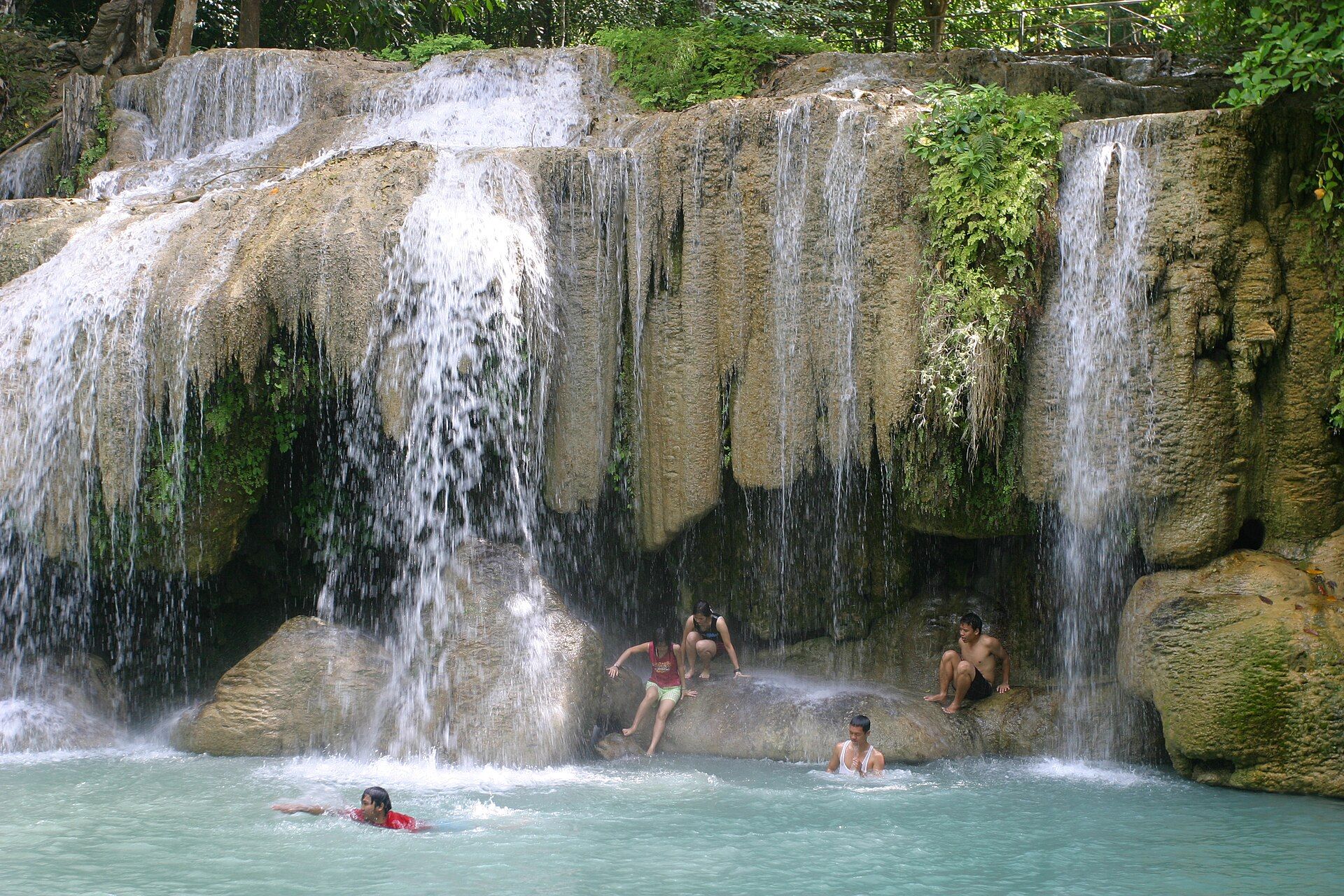
Erawan Falls steps down the hills of Kanchanaburi Province in seven tiers, each spilling into a clear blue-green pool held by travertine dams. A marked trail climbs about 1.5 km to the seventh tier, with small fish nibbling at swimmers in the pools. The falls are the centrepiece of Erawan National Park, which also protects limestone caves and forest with gibbons, macaques and hornbills.
- Seven distinct tiers — more pools, and quieter ones higher up
- Runs year-round, fullest in and after the rains
- Reachable from Bangkok, via Kanchanaburi
Head to head
| What matters | Kuang Si Falls | Erawan Falls |
|---|---|---|
| Shape of the falls Edge: Toss-up | One main drop of about 50 m, then a staircase of terraced pools below it. | Seven separate tiers spread up the hillside over roughly 1.5 km; no single dominant drop. |
| The walk Edge: Kuang Si Falls | Easy: a short forest trail links the pools and viewpoints, with a steeper, slippery path to the top of the main fall. | Moderate: steps, roots and short scrambles between tiers. The upper tiers close in the afternoon, so the last ascent is timed. |
| Swimming Edge: Toss-up | Several terraces open for swimming beneath the cascades. | Many pools open for swimming; small fish nibble at your feet. |
| Getting there Edge: Kuang Si Falls | Fly or take the fast train to Luang Prabang, then about 1h by tuk-tuk, minibus or tour. | Bangkok to Kanchanaburi by road or train, roughly 2–3h, then on by road to the park. A long day trip from Bangkok, an easy half-day from Kanchanaburi. |
| Time at the site Edge: Toss-up | 2–4 hours to walk, swim and see the bear sanctuary. | 3–5 hours to climb all seven tiers, swim and return. |
| Crowds Edge: Toss-up | Busy at midday when the tours arrive; early morning and late afternoon are much calmer. | Busy on weekends and Thai holidays, especially the lower pools; weekdays, early starts and the upper tiers are calmer. |
| Best months Edge: Toss-up | November–April, the dry season, for the clearest turquoise water. The rains add flow but can turn the pools brown. | November–February for the most comfortable walk and swim; flow is strongest in and just after the rains (roughly July–November). |
| Rules and facilities Edge: Toss-up | Ticketed park with toilets, changing areas and food stalls near the entrance. | National park entry, higher for foreign visitors. Food and large bottles are restricted on the upper trail and litter rules are enforced; facilities only at the entrance. |
Which should you choose?
Choose Kuang Si Falls if…
…you are in Luang Prabang, want one big photogenic waterfall with an easy walk, or are travelling with people who don't want a long climb.
Choose Erawan Falls if…
…you are based in Bangkok or Kanchanaburi, enjoy a longer forest walk, or want to keep climbing past the crowds to quieter upper pools.
The honest verdict
These are two versions of the same thing, so choose by route rather than by beauty. If you are going to Luang Prabang, Kuang Si is the obvious half-day: one tall fall, easy paths and the bear sanctuary, about an hour from town. If you are in Thailand, Erawan is the one within reach of Bangkok.
Erawan is the better walk — seven tiers, with the higher pools quieter than the lower ones — but it takes longer and the upper trail closes in the afternoon, so start early. Kuang Si is the better single view. At both, arrive early or late to swim before the tour groups, and wear grippy sandals for the wet travertine.
Both are clearest in the dry season: Kuang Si from November to April, Erawan from November to February. In the rains both run harder but lose some of their colour.
Wonders mentioned here
Added