Si Phan Don & the Khone Falls
📍 Khong District, Champasak Province, southern Laos
Where the Mekong spreads fourteen kilometres wide and breaks into thousands of islands — and then falls over the widest waterfall on Earth, the barrier that stopped the river ever becoming a highway to China.
What makes it marvelous
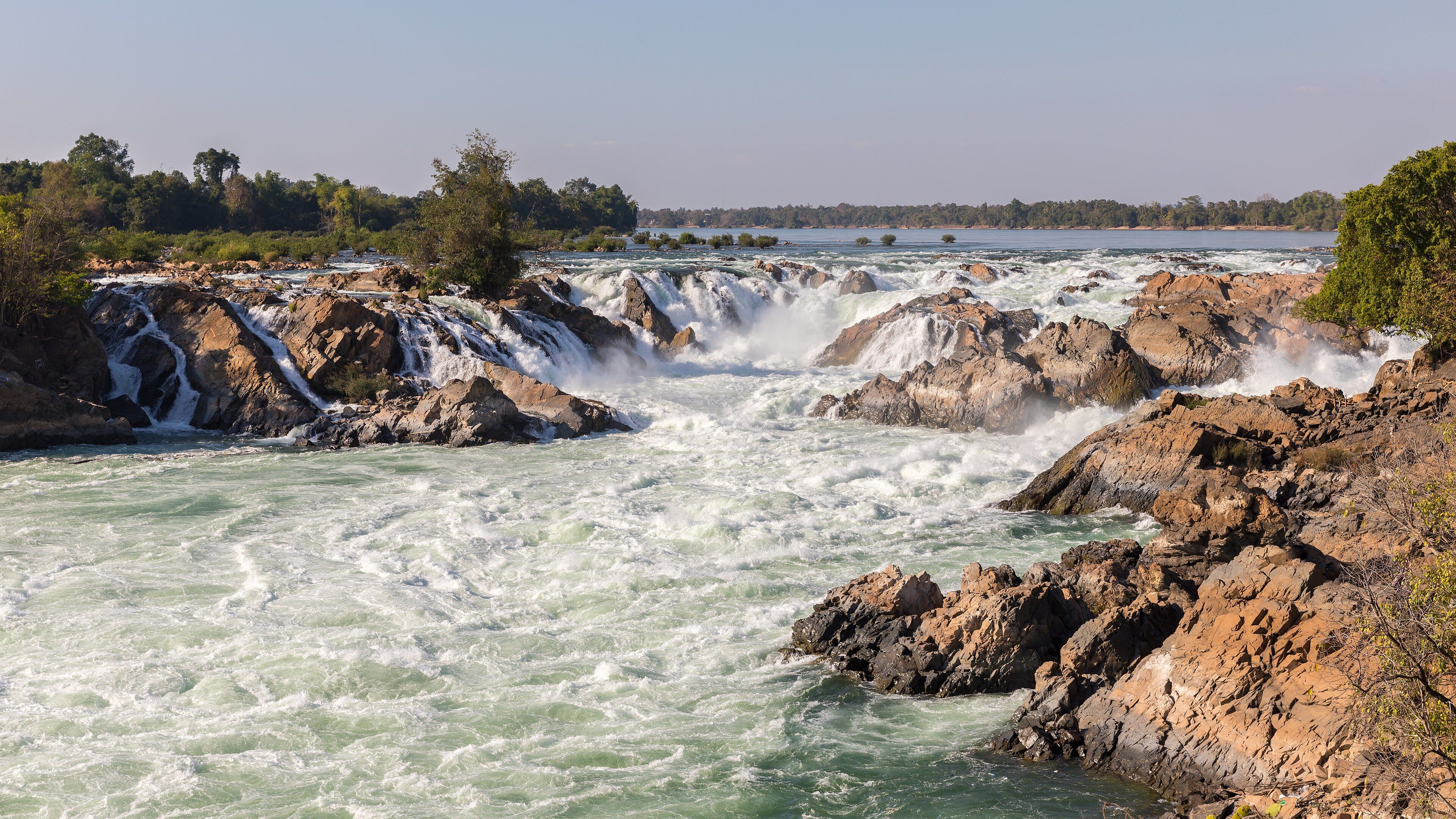
Approaching the Cambodian border the Mekong loses its channel and sprawls, splitting around an archipelago the Lao call Si Phan Don — four thousand islands, roughly half of which vanish under water when the river is in flood. At the southern end the whole braided river drops through the Khone Falls, which is not a single curtain but a nine-kilometre run of rapids and cataracts spread across every channel at once. Measured from the outermost edge of one channel to the other it is 10,783 metres across, making it the widest waterfall in the world; the highest individual drop is about 21 metres, and average discharge is close to 11,000 cubic metres a second, with a recorded peak above 49,000. This is the reason the Mekong has never been navigable from the sea to China. French colonial engineers tried repeatedly to get boats through, failed, and ended up building a narrow-gauge railway across two of the islands to portage around it — the first railway ever laid in Laos, and for a long time the only one.
Why visit
It is the one stretch of the Mekong where you can see what the river actually does when nothing constrains it: hundreds of channels, sandbars, submerged forest and islands that appear and disappear with the season. Life on the islands runs at the pace of a river that floods every year, and the falls themselves are genuinely loud — a wall of white water spread further than you can see in either direction.
What to know before you go
🗓️ Best time
November to February is the dry season and the easiest time to be here: comfortable temperatures, clear skies, calm water for boats. The falls are at their most violent from July to September at the peak of the monsoon, but travel is harder and many channels are dangerous.
🧭 Getting there & access
Pakse is the nearest city and the usual arrival point, roughly three hours north by road. From Nakasang on the mainland, boats cross to Don Det and Don Khon in a few minutes; Don Khong, the largest island, is reached by bridge. Khone Phapheng, the most visited section of the falls, is on the mainland east bank and is ticketed.
Good to know
- The Don Det–Don Khon railway bed is now a walking and cycling route past the falls — the best way to see the cataracts up close.
- Do not swim near the channels above or below the falls; the current is far stronger than it looks from the bank.
- Dolphin-watching trips are still sold here. The dolphins are gone from Lao waters — see below before you book.
- Bring cash. There is very little banking on the islands.
Plan your visit
Easy🧭 Getting there
From Pakse (PKZ), Laos
- Fly or travel overland to Pakse in southern Laos
- Drive roughly three hours south to Nakasang or the Don Khong bridge
- Cross by boat to Don Det or Don Khon, or drive onto Don Khong
- Visit Khone Phapheng on the mainland east bank separately
- Total travel
- Half a day from Pakse
- Time at site
- 2–3 days
- Access
- The islands are freely accessible and reached by public boat. Khone Phapheng and the Li Phi section charge entry. Boat operators work to informal schedules; agree the return before you set out, especially late in the day.
🎒 What to bring & consider
- Cash in kip; card facilities are minimal on the islands
- Sun protection — there is very little shade on the water
- A bicycle, hired locally, which is how the islands are best covered
- Insect repellent for dusk on the riverbank
- Patience with boat timings, which are approximate
👁️ What to expect
- Crowds
- Don Det has a long-standing backpacker scene; Don Khong and the smaller islands are quiet. Khone Phapheng gets coach groups midday.
- Conditions
- Hot and humid year-round. Flat, easy ground; travel is by boat and bicycle.
- Facilities
- Guesthouses, restaurants and bike hire on Don Det, Don Khon and Don Khong. A visitor centre at Khone Phapheng.
- The view
- The braided cataracts of Khone Phapheng from the viewing platforms in late afternoon, with the islands strung out behind the white water.
Times and requirements are approximate and change with season, weather, and local rules — confirm permits, fares, and schedules with operators before you travel.
Natural riches of the area
- A braided reach of the Mekong holding thousands of seasonal and permanent islands
- The Khone Falls — at 10,783 m across, the widest waterfall in the world
- Average discharge near 11,000 m³/s, with recorded peaks above 49,000 m³/s
- Seasonally flooded island forest and sandbars that reform every year
- One of the most species-rich freshwater fisheries on Earth, including giant Mekong catfish
Local food
- Laap pa
- Minced river fish with herbs, lime, chilli and toasted rice powder.
- Mok pa
- Fish steamed in banana leaf with dill and lemongrass.
- Khao niao
- Sticky rice, eaten by hand with everything, served in a woven basket.
- Tam mak hoong
- Green papaya salad, pounded to order and hotter than its Thai cousin.
For most of its length the Mekong behaves like a river. In southern Laos, just before the Cambodian border, it stops. The channel gives out, the water spreads across a floodplain fourteen kilometres wide, and what had been one river becomes hundreds of them threading between islands. The Lao name for the reach is Si Phan Don — four thousand islands — and about half of those islands are only islands for part of the year. When the monsoon flood arrives they go under.
At the southern edge of the archipelago the whole thing falls. The Khone Falls are not a single sheet of water but a nine-and-a-half-kilometre run of rapids and cataracts happening in every channel at once, and measured across all of them the falls are 10,783 metres wide — the widest waterfall in the world. No individual drop is enormous; the tallest is around 21 metres. The volume is what makes it: an average of some 11,000 cubic metres a second, and once, on record, more than 49,000.
That barrier has decided a lot of history. The Mekong runs from the Tibetan Plateau to the South China Sea, and it has never been navigable end to end because of this one obstacle. French colonial engineers spent years trying to force boats through, gave up, and instead laid a narrow-gauge railway across the islands of Don Det and Don Khon to carry cargo and passengers around the falls — the first railway built in Laos. Its bed is now a path, and walking it is still the best way to reach the cataracts.
One thing worth knowing before you go. Si Phan Don was for decades the place to see Irrawaddy dolphins, which held on in a deep pool straddling the Lao–Cambodian border. That subpopulation was declared functionally extinct in 2016, and the last individual in it died in February 2022 after being caught in fishing gear. There are no Irrawaddy dolphins left in Laos. Fewer than a hundred survive downstream in Cambodia. Trips are still advertised here; they are looking across the border at best, and at nothing at worst.
Si Phan Don & the Khone Falls: common questions
How do you get to Si Phan Don & the Khone Falls?
From Pakse (PKZ), Laos: Fly or travel overland to Pakse in southern Laos; Drive roughly three hours south to Nakasang or the Don Khong bridge; Cross by boat to Don Det or Don Khon, or drive onto Don Khong; Visit Khone Phapheng on the mainland east bank separately. Total travel time: Half a day from Pakse.
When is the best time to visit Si Phan Don & the Khone Falls?
November to February is the dry season and the easiest time to be here: comfortable temperatures, clear skies, calm water for boats. The falls are at their most violent from July to September at the peak of the monsoon, but travel is harder and many channels are dangerous.
How long should you spend at Si Phan Don & the Khone Falls?
2–3 days. Total travel time: Half a day from Pakse.
What should you bring to Si Phan Don & the Khone Falls?
Cash in kip; card facilities are minimal on the islands Sun protection — there is very little shade on the water A bicycle, hired locally, which is how the islands are best covered Insect repellent for dusk on the riverbank Patience with boat timings, which are approximate
Do you need a permit or guide for Si Phan Don & the Khone Falls?
The islands are freely accessible and reached by public boat. Khone Phapheng and the Li Phi section charge entry. Boat operators work to informal schedules; agree the return before you set out, especially late in the day.
Is Si Phan Don & the Khone Falls crowded, and what are conditions like?
Don Det has a long-standing backpacker scene; Don Khong and the smaller islands are quiet. Khone Phapheng gets coach groups midday. Hot and humid year-round. Flat, easy ground; travel is by boat and bicycle. Facilities: Guesthouses, restaurants and bike hire on Don Det, Don Khon and Don Khong. A visitor centre at Khone Phapheng.
Added
More wonders to explore