The Boiling Lake
📍 Morne Trois Pitons National Park, Dominica
A flooded fumarole in the Dominican interior whose centre boils continuously — the second-largest hot lake on Earth, reached only by a six-hour walk across a valley of steam vents.
What makes it marvelous
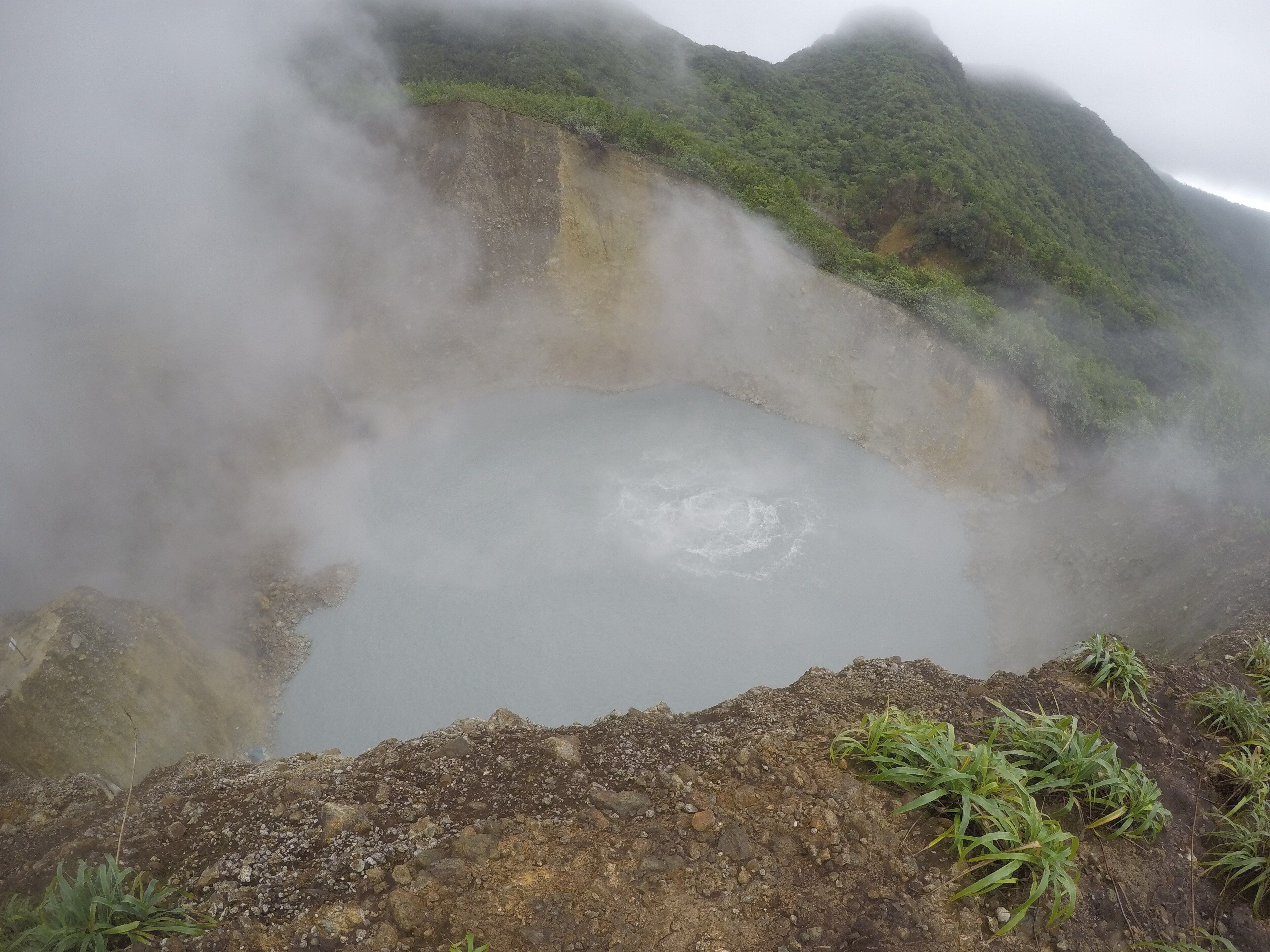
The Boiling Lake is not a lake that happens to be hot. It is a fumarole — a vent for gas escaping from magma below — that has filled with water, and the flooded vent is still doing its job. The centre is in a permanent rolling boil under a cloud of vapour; measurements taken at the edges have found temperatures between 82 and 92 °C, and nobody has succeeded in measuring the middle. It is roughly 60 to 75 metres across, which makes it the second-largest hot lake in the world after Frying Pan Lake in New Zealand's Waimangu Valley. What is strangest about it is how unstable it is. The lake sits well above the local water table, held up by a continuous flux of steam and gas from below, so an interruption in that supply lets it drain away through the same porous connection that heats it. It vanished entirely after a nearby steam explosion in 1880. Between December 2004 and April 2005 it dropped by about ten metres — then refilled in a single day.
Why visit
The walk to it is as much the point as the lake. The route crosses the Valley of Desolation, a bare, sulphurous basin of hissing vents, hot pools and small geysers set in the middle of otherwise dense rainforest, and then climbs to a ledge about thirty metres above the water where the whole boiling surface is laid out below you. Dominica has almost no beach tourism and this is the clearest expression of why it is called the Nature Island.
What to know before you go
🗓️ Best time
February to April is driest and gives the firmest footing on a trail that is treacherous when wet. December to April is the broader dry window. The hurricane season from June to November brings heavy rain, and the trail is often closed or unwise after storms.
🧭 Getting there & access
The trailhead is at Laudat, about half an hour from Roseau. The Boiling Lake Trail runs roughly 13 km round trip and takes about six hours in total, in three roughly hour-long stages each way: Laudat to Breakfast River, then up Morne Nicholls at 966 metres, then a steep descent into the Valley of Desolation and along to the overlook. A guide is required in practice and strongly advised in every account of the route.
Good to know
- Go with a guide. The Valley of Desolation has thin ground over hot water and the safe line through it is not obvious.
- Fill up at Breakfast River — it is the last clean water on the route.
- Keep to the guide's footsteps in the valley; small invisible steam jets will scald an ankle.
- Start early. Six hours plus stops means an afternoon finish even on a prompt start.
Plan your visit
Strenuous🧭 Getting there
From Roseau, Dominica
- Arrive in Dominica at Douglas–Charles airport or by ferry
- Base in or near Roseau
- Drive about 30 minutes to the trailhead at Laudat
- Walk the Boiling Lake Trail via Breakfast River, Morne Nicholls and the Valley of Desolation
- Total travel
- About half an hour from Roseau to the trailhead
- Time at site
- A full day for the walk in and out
- Access
- A national park site pass is required and is sold at the trailhead and elsewhere on the island. Guides are booked in Roseau or Laudat; going unguided is not advisable and is discouraged. The trail closes after storms and after volcanic activity changes — check locally on the day.
🎒 What to bring & consider
- A guide — this is the one item not to economise on
- Boots with real grip; the route is steep, muddy and rooty throughout
- At least two litres of water, refilled at Breakfast River
- Long trousers for the scrambling sections
- A dry layer for the top of Morne Nicholls, which is cold and windy
👁️ What to expect
- Crowds
- Modest. Dominica sees few visitors and this trail filters most of them out.
- Conditions
- Six hours of steep, wet, root-crossed trail, then bare volcanic ground that is hot underfoot in places.
- Facilities
- Nothing on the route beyond the trailhead. No shelter, no toilets, no signal for most of it.
- The view
- The lake from the overlook when the wind briefly clears the vapour and the rolling boil at the centre becomes visible.
Times and requirements are approximate and change with season, weather, and local rules — confirm permits, fares, and schedules with operators before you travel.
Natural riches of the area
- A flooded fumarole roughly 60–75 m across, the second-largest hot lake in the world
- Edge temperatures of 82–92 °C, with the centre in permanent boil
- The Valley of Desolation — sulphur springs, hot pools, fumaroles and small geysers
- A lake suspended above the water table that has drained and refilled within living memory
- Dense montane rainforest on every approach to the volcanic ground
Local food
- Callaloo soup
- Dasheen leaves cooked down with coconut and seasoning, Dominica's staple soup.
- Mountain chicken
- Historically the national dish, from a giant frog now critically endangered and protected — no longer eaten.
- Crab backs
- Land-crab meat seasoned and returned to the shell.
- Bush tea
- Infusions from the forest herbs Dominica grows in abundance.
The name is not a metaphor. The centre of the Boiling Lake is genuinely boiling, continuously, under a permanent cloud of steam, and it has been doing so for as long as anyone has been looking. Measurements taken from the edges in the 1870s found the water between 82 and 92 °C; nobody has managed a reading from the middle, where it is in full rolling boil.
Strictly it is not a lake at all but a flooded fumarole — a vent that carries gas and steam up from magma below, which has filled with rainwater and two small streams and now boils what collects in it. At roughly 60 to 75 metres across it is the second-largest hot lake in the world, behind Frying Pan Lake in New Zealand.
The consequence of being a vent rather than a basin is that the lake is held up rather than held in. It sits well above the local water table, supported by the continuous upward flux of gas, and when that flux is interrupted the water drains back down through the same connection. This has happened more than once. A steam explosion nearby in 1880 emptied it entirely and replaced it with a fountain of hot water. Between December 2004 and April 2005 the level fell about ten metres — and then the lake refilled in a single day.
Getting there is a commitment. There is no road; the trail from Laudat is around 13 kilometres in and out and takes about six hours, climbing over Morne Nicholls at 966 metres before dropping into the Valley of Desolation. That valley is the memorable part for most people: a bare, steaming, sulphurous basin of hot pools and hissing vents in the middle of otherwise unbroken rainforest, where the crust is thin in places and the safe line is genuinely not obvious. Two members of a hiking party died here in 1900 from a sudden release of volcanic gas. Take a guide.
The Boiling Lake: common questions
How do you get to The Boiling Lake?
From Roseau, Dominica: Arrive in Dominica at Douglas–Charles airport or by ferry; Base in or near Roseau; Drive about 30 minutes to the trailhead at Laudat; Walk the Boiling Lake Trail via Breakfast River, Morne Nicholls and the Valley of Desolation. Total travel time: About half an hour from Roseau to the trailhead.
When is the best time to visit The Boiling Lake?
February to April is driest and gives the firmest footing on a trail that is treacherous when wet. December to April is the broader dry window. The hurricane season from June to November brings heavy rain, and the trail is often closed or unwise after storms.
How long should you spend at The Boiling Lake?
A full day for the walk in and out. Total travel time: About half an hour from Roseau to the trailhead.
What should you bring to The Boiling Lake?
A guide — this is the one item not to economise on Boots with real grip; the route is steep, muddy and rooty throughout At least two litres of water, refilled at Breakfast River Long trousers for the scrambling sections A dry layer for the top of Morne Nicholls, which is cold and windy
Do you need a permit or guide for The Boiling Lake?
A national park site pass is required and is sold at the trailhead and elsewhere on the island. Guides are booked in Roseau or Laudat; going unguided is not advisable and is discouraged. The trail closes after storms and after volcanic activity changes — check locally on the day.
Is The Boiling Lake crowded, and what are conditions like?
Modest. Dominica sees few visitors and this trail filters most of them out. Six hours of steep, wet, root-crossed trail, then bare volcanic ground that is hot underfoot in places. Facilities: Nothing on the route beyond the trailhead. No shelter, no toilets, no signal for most of it.
Added