🇩🇲 Natural wonders of Dominica
The youngest and steepest of the Lesser Antilles — nine potentially active volcanoes on one small island, hot springs and fumaroles throughout, and rainforest instead of resorts.
🗓️ Best time for nature: December to April is the dry season and the practical window for hiking, with February to April driest of all. The hurricane season runs June to November and brings heavy rain that closes trails.
The lay of the land
Dominica is geologically the youngest island in the Lesser Antilles and it shows in every direction: steep volcanic ridges, deep river valleys and almost no flat ground. The island carries nine volcanoes considered potentially active — an unusually high concentration for its size — and the geothermal system beneath them surfaces everywhere as hot springs, fumaroles, sulphur vents and, at the extreme, a permanently boiling lake in the interior. Rainfall on the high ground is enormous, feeding a claimed 365 rivers and keeping the interior under dense montane rainforest and elfin woodland. Because there is so little beach and so much slope, the island never developed mass tourism, and its natural cover is intact to a degree unusual in the Caribbean.
Where to begin
-
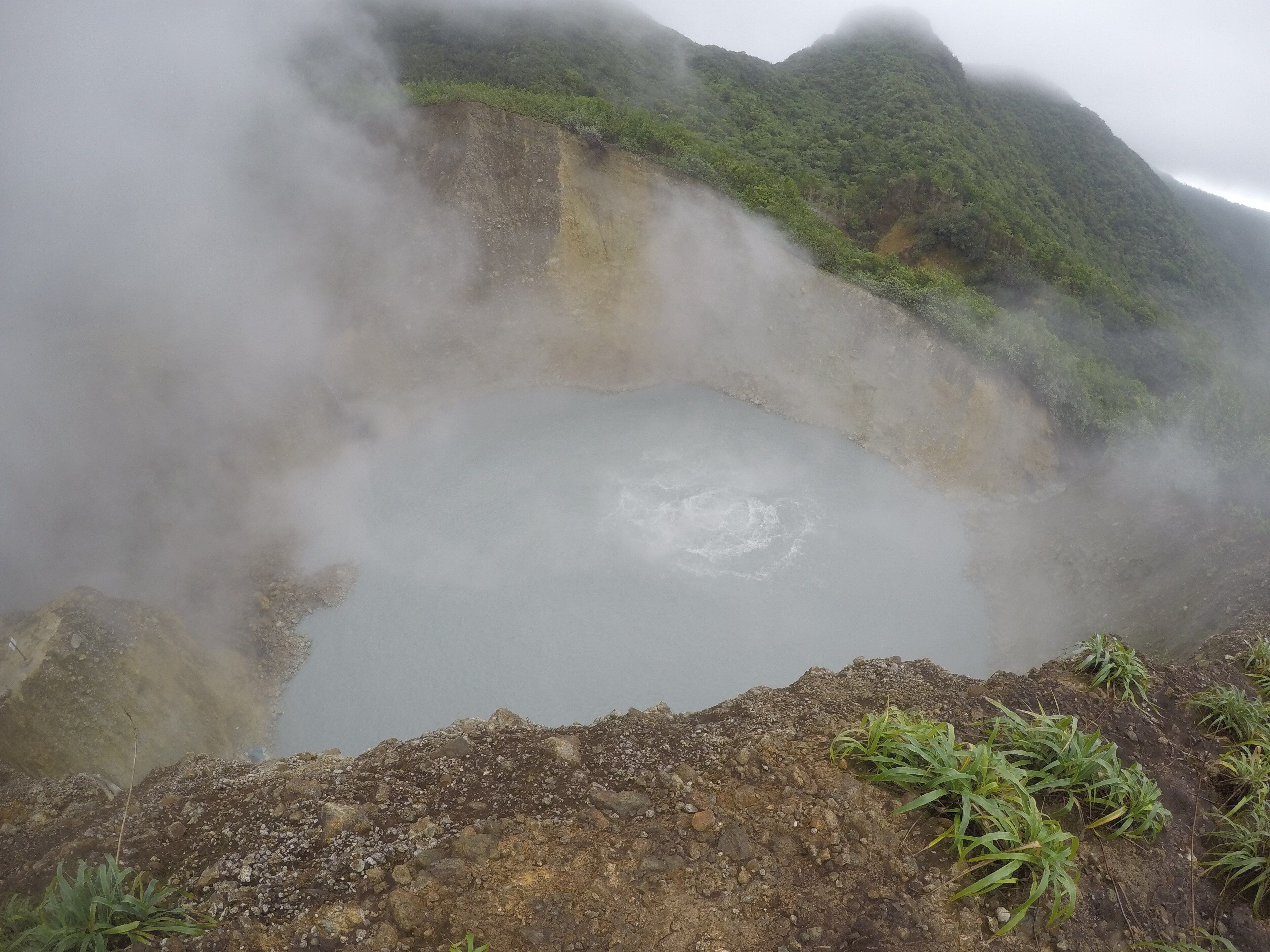
The Boiling Lake
A flooded fumarole in permanent boil — the second-largest hot lake in the world, six hours' walk from the road.
A taste of the place
Dominican cooking leans on what grows on the slopes: dasheen and other ground provisions, plantain, breadfruit and coconut, with callaloo soup as the everyday dish and river crayfish and land crab where they can be had. The 'mountain chicken' that was historically the national dish is a giant frog now critically endangered and legally protected, and is no longer on any menu.
Traveling responsibly
- This is a hiking island. Bring boots, not beach kit.
- Trails close after storms and are often genuinely impassable — check locally on the day.
- The Waitukubuli National Trail runs the length of the island in fourteen segments if you want more than a day walk.
Dominica is not the Dominican Republic, and it is not a beach holiday. It is the youngest island in the Lesser Antilles, which in practice means it has not had time to be worn flat: the whole thing is steep volcanic ridge and deep river valley, with very little level ground anywhere and almost no sand.
What it has instead is heat from below. Nine of its volcanoes are considered potentially active — a remarkable concentration for an island this size — and the geothermal system underneath surfaces continuously as hot springs, sulphur vents and fumaroles. In the interior, inside Morne Trois Pitons National Park, that system produces the Boiling Lake: a flooded fumarole whose centre boils permanently, and which is reached only by a six-hour walk across a valley of steam vents.
The rest of the island is water and forest. Rainfall on the high ridges is extreme, the island claims a river for every day of the year, and the interior stays under montane rainforest that thins into elfin woodland on the summits. Because there was never enough beach to build a resort economy on, Dominica ended up marketing itself as the Nature Island — which for once is an accurate description rather than a slogan.
Added
All wonders in Dominica
1 places