🇧🇦 Natural wonders of Bosnia and Herzegovina
Two landscapes under one name — forested Dinaric mountains and wild rivers in the north, bare limestone karst and turquoise water in the south, with some of the last old-growth forest in Europe.
🗓️ Best time for nature: May to June has the highest river flow and the greenest landscape; September and early October are warm, quiet and clear. July and August are hot and busy at the waterfalls. Winter is a genuine ski season in the mountains above Sarajevo.
The lay of the land
The country divides in two along its name. Bosnia, the northern and central part, is mountain and forest — the Dinaric Alps running southeast, cut by rivers that are among the least developed in Europe. The Una, the Neretva and the Tara all still run largely wild, and Sutjeska National Park holds Perućica, one of the last primeval forests left on the continent. Herzegovina, in the south, is classic karst: bare grey limestone, poljes, sinkholes, underground drainage and rivers that appear from cave mouths already full. Because that water is saturated with dissolved carbonate, several of the rivers deposit rather than erode, building tufa barriers and cascades — Kravica on the Trebižat is the largest of them. The two halves look and feel entirely unalike within a couple of hours' drive.
Where to begin
-
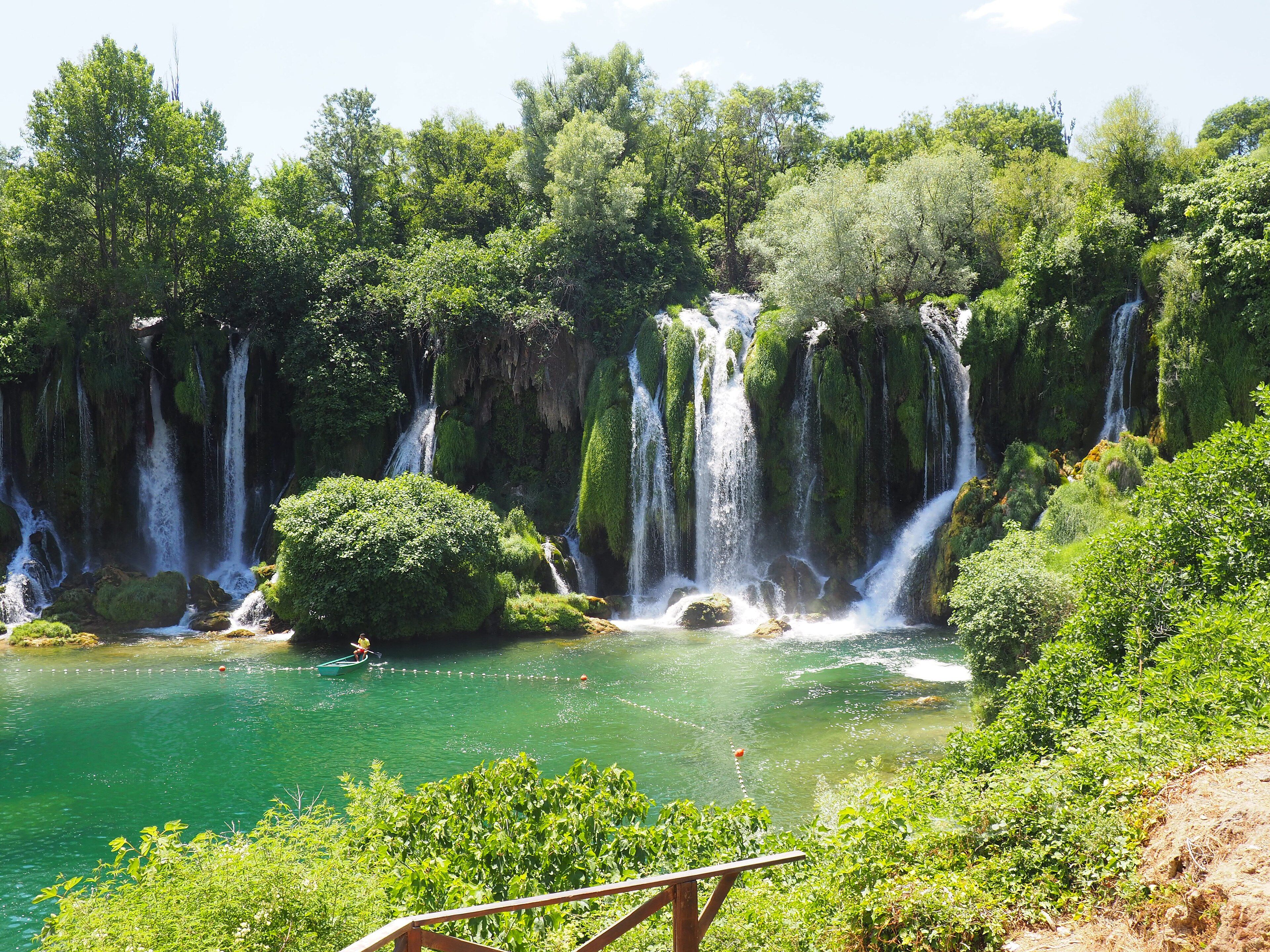
Kravica Falls
A 25-metre tufa cascade on the Trebižat, still building itself out of the water it carries.
A taste of the place
Ottoman and Mediterranean influences meet here: ćevapi with flatbread and onion, burek and other coiled pies, meat baked slowly under a peka bell, and grilled river trout. Herzegovina grows its own wine, chiefly Žilavka and Blatina, on the karst around Mostar and Ljubuški.
Traveling responsibly
- A car is close to essential; public transport between regions is slow and infrequent.
- Stick to marked paths and roads in rural areas — landmine clearance from the 1990s is not complete everywhere, and marked areas are marked for a reason.
- Mostar and the southern waterfalls fill with day-trippers from the Croatian coast; go early.
The country’s name describes two different landscapes, and the difference is real. Bosnia, in the north and centre, is Dinaric mountain and forest — steep, wet and green, cut by rivers that are among the least engineered in Europe. The Una, the Neretva and the Tara all still run substantially wild, and Sutjeska National Park protects Perućica, one of very few primeval forests left anywhere on the continent.
Herzegovina, to the south, is the opposite: bare grey limestone karst, with poljes, sinkholes and rivers that disappear underground and reappear from cave mouths already at full volume. Very little grows on the rock, and the contrast when you reach water is abrupt.
What that water does is the interesting part. It comes out of the limestone loaded with dissolved calcium carbonate, and where mosses and algae grow in the spray, the carbonate precipitates and hardens into tufa. So instead of cutting downward, several Herzegovinian rivers build upward — depositing barriers and cascades of living rock, the same process that produced Plitvice over the Croatian border. Kravica, on the Trebižat near Ljubuški, is the largest of them: a 25-metre arc of water into a broad green pool, in the middle of an otherwise dry stony landscape.
One practical note that applies nowhere else in this region quite as strongly: mine clearance from the 1990s is still incomplete in parts of the countryside. Marked areas are marked accurately, marked paths are the safe ones, and this is not the country in which to improvise a cross-country route.
Added
All wonders in Bosnia and Herzegovina
1 places