🇩🇯 Natural wonders of Djibouti
A small country sitting on a three-way tectonic junction — lava fields, salt lakes below sea level, and a strait where whale sharks gather every winter.
🗓️ Best time for nature: November to February is the only comfortable season, and even then daytime temperatures run around 34 °C. Whale sharks are in the Gulf of Tadjoura from roughly October to February. From May to September the interior reaches 52 °C and travel outside the city is inadvisable.
The lay of the land
Djibouti occupies the Afar Triangle, one of the few places on land where three tectonic plates are actively pulling apart — the Nubian, Somali and Arabian. The consequences are everywhere. The country is largely basalt: young lava fields, fissures, cinder cones and the Ardoukoba volcano, which erupted as recently as 1978. The crust is being stretched and dropped, which is why Lake Assal sits 155 metres below sea level, the lowest point on land in Africa, with no outflow and brine ten times as salty as the sea. Between the volcanic ground and the Gulf of Aden, the Gulf of Tadjoura and the narrow Bab-el-Mandeb strait funnel plankton and with it whale sharks, which gather here in numbers each winter. Inland, the Goda and Mabla massifs hold small relict stands of Bankoualé palm and juniper — the last remnants of forest in an otherwise desert country.
Where to begin
-
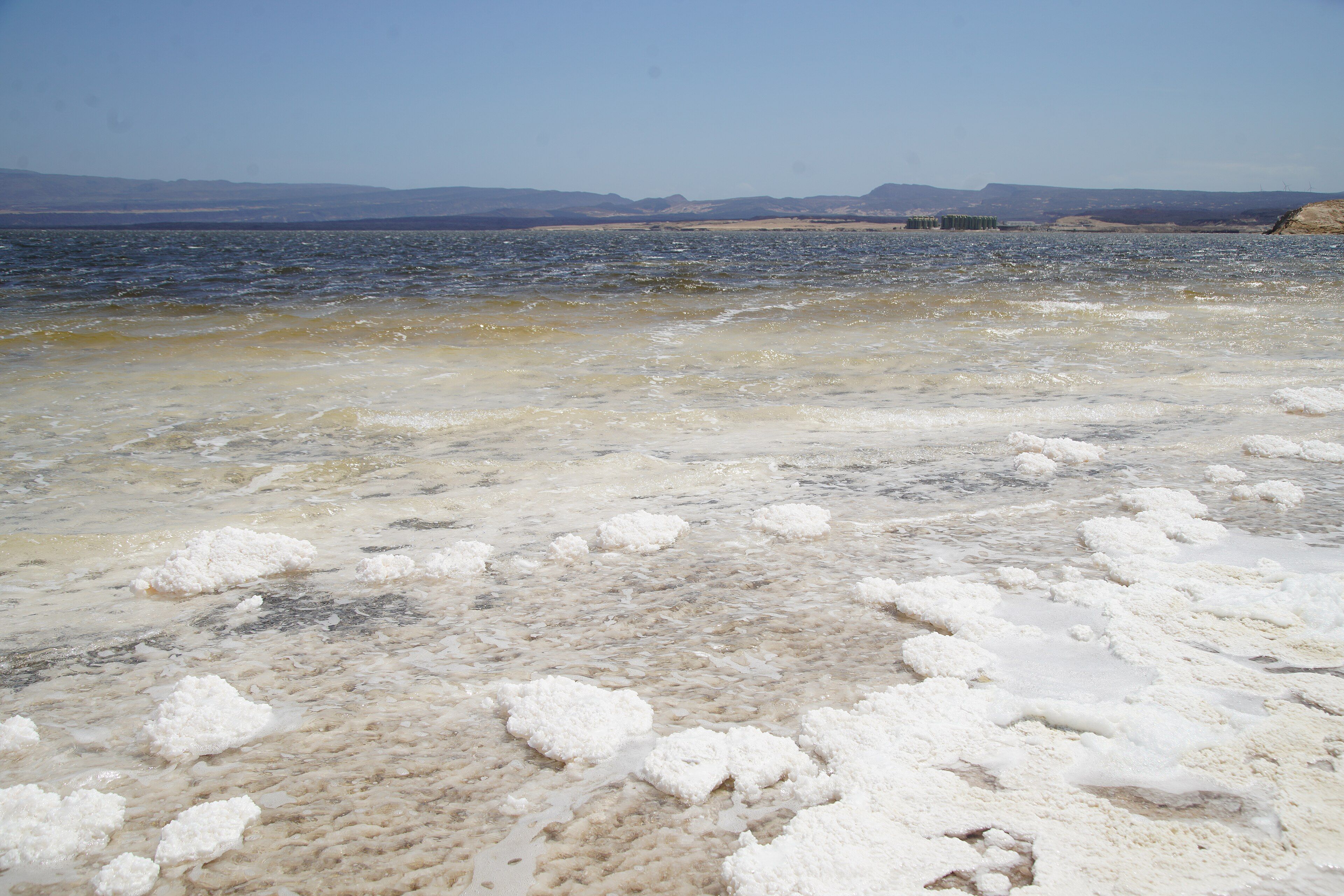
Lake Assal
The lowest point on land in Africa, with a salt plain sixty metres deep along its shore.
A taste of the place
Djiboutian cooking sits between the Horn of Africa, Yemen and France: skoudehkaris, rice with lamb and cardamom, is the national dish; lahoh, a spongy fermented flatbread, appears at breakfast; fah-fah is a spiced goat soup; and fish from the Red Sea and Gulf of Aden is grilled in clay ovens in the capital.
Traveling responsibly
- Travel in winter. Summer heat in the interior is a genuine safety issue, not a discomfort.
- There is no meaningful public transport to the natural sites — hire a vehicle and driver.
- Carry all your own water everywhere outside the city. There is none at any of the sites.
Djibouti is small, extremely hot, and sitting on top of something geologically remarkable. It occupies the Afar Triangle, one of the very few places on Earth where three tectonic plates are pulling apart at the surface rather than under an ocean — the Nubian, Somali and Arabian plates, separating along the line that will eventually split the Horn of Africa away from the rest of the continent.
The country reads as a record of that. It is largely basalt: young lava fields, open fissures, cinder cones, and the Ardoukoba volcano, which last erupted in 1978. Where the crust has been stretched and dropped, the ground has gone below sea level, and in one closed depression 120 kilometres west of the capital it has gone 155 metres below — the lowest point on land anywhere in Africa. That depression holds Lake Assal, which takes seawater in underground from the Gulf of Tadjoura, has no outlet at all, and evaporates in 52 °C summers until the brine is ten times as salty as the ocean and the salt has crystallised into a white plain sixty metres thick.
The sea does something almost as unlikely. The Gulf of Tadjoura and the narrow Bab-el-Mandeb strait concentrate plankton, and whale sharks come in to feed on it through the winter, which has made a country most people cannot place on a map one of the more reliable places to swim with them.
Inland, in the Goda and Mabla massifs, there is one more surprise: small relict stands of juniper and Bankoualé palm, the last fragments of forest left in a country that is otherwise desert.
Added
All wonders in Djibouti
1 places