🇦🇱 Natural wonders of Albania
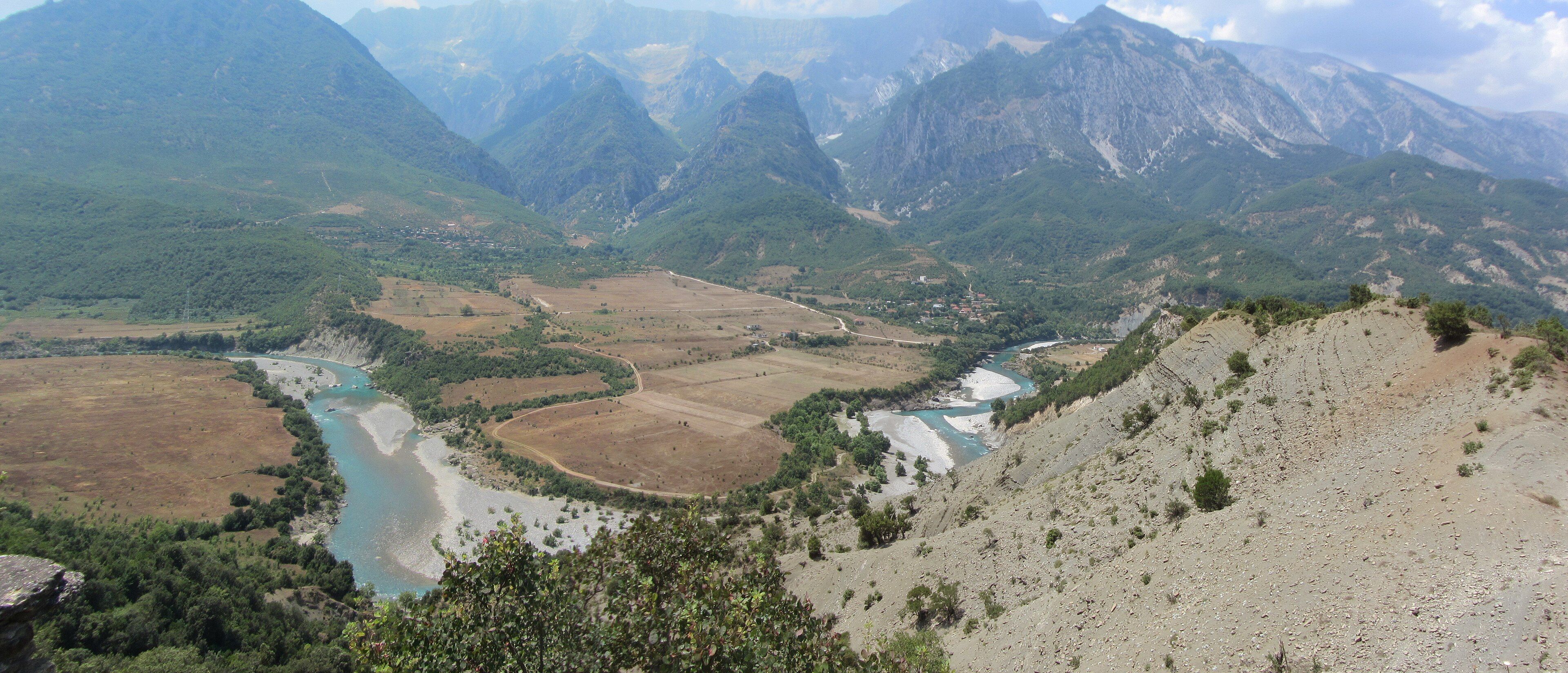
Limestone mountains over most of its area and a coast on two seas — with the Vjosa, the last large free-flowing river in Europe, running undammed for 192 kilometres to the Adriatic.
🗓️ Best time for nature: May to June and September to October are the best all-round months, warm without the July and August crowds on the coast. Mountain trails in the north are clear from June to October. Winter is cold and wet inland and much of the high country closes.
The lay of the land
Albania is mountainous over roughly three-quarters of its area, mostly limestone, and it meets the sea twice — the Adriatic in the north and west, the Ionian along the southern Riviera, with the two divided at the Ceraunian Mountains. The northern Albanian Alps are hard, glaciated karst, cut by the Valbona and Shala valleys. The south is softer country of long river valleys and thermal springs, and it holds what is now the most significant thing in Albanian nature: the Vjosa, which runs 192 kilometres from the Greek border to the Adriatic without a dam and still braids across its own gravel the way rivers did before they were managed. Decades of isolation under a closed regime left the country with very little industrial development in the interior, which is a large part of why so much of it survived intact.
Where to begin
-
The Vjosa
Europe's last large wild river, braided across its gravel and undammed to the sea — a national park since 2023.
A taste of the place
Albanian cooking is Mediterranean with Ottoman edges: byrek pastries, tavë kosi of lamb baked under yoghurt, grilled fish on the coast, and a great deal of cheese, yoghurt and olive oil. The upper Vjosa valley around Përmet is known for gliko, whole fruit preserved in syrup, and for home-distilled raki.
Traveling responsibly
- Rent a car. Public transport between regions is slow and indirect, and the best country is off the main routes.
- Distances are short and journey times are not — mountain roads here are genuinely slow.
- The coast is packed in August; the interior is not, in any month.
Albania spent most of the twentieth century closed, and one accidental consequence is a country whose interior was never industrialised, never dammed to the extent its neighbours were, and never built over. About three-quarters of it is mountain, mostly limestone, running from the hard glaciated karst of the Albanian Alps in the north down through long river valleys to the Ceraunian range where the Adriatic gives way to the Ionian.
The most significant piece of Albanian nature is a river. The Vjosa rises in the Greek Pindus, enters Albania in the southeast, and runs 192 kilometres to the Adriatic without a single dam — braiding into multiple channels across broad white gravel bars, moving its course from year to year, doing all the things that European rivers used to do and mostly no longer can. A series of hydropower schemes was proposed along it through the 2010s; a long campaign fought them, and in March 2023 the government declared the river and its main tributaries the Vjosa Wild River National Park, the first park in Europe created specifically to keep a river wild.
Everything else follows from the terrain. The north has the trekking — Theth, Valbona, the high passes between them. The south has the thermal springs, the river valleys and the Riviera. And because the roads are slow and the distances deceptive, the country still rewards going inland, which is where most visitors never get to.
Added
All wonders in Albania
1 places